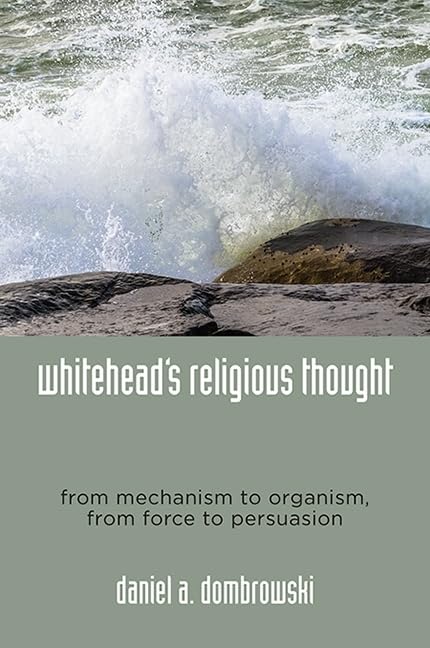
Whitehead’s Religious Thought: From Mechanism to Organism, From Force to Persuasion
- By Daniel Dombrowski
- January 2, 2018
- SUNY Press
This original interpretation of the religious thought of Alfred North Whitehead highlights Whitehead’s moves from mechanism to organism, and from force to persuasion to offer a third alternative between classical theism and religious skepticism. Daniel A. Dombrowski argues that the move from force to persuasion, in particular, is not only fundamental to Whitehead’s own thought and to process thought in general, but is a necessary condition for the continuing existence of civilized life. Following this line of analysis, Dombrowski demonstrates Whitehead’s relevance to contemporary work in philosophy of mind, political philosophy, and environmental ethics by placing him in dialogue with six major thinkers: David Ray Griffin, Isabelle Stengers, John Rawls, Charles Hartshorne, Judith Butler, and William Wordsworth.
- Get a Copy of Whitehead’s Religious Thought: From Mechanism to Organism, From Force to Persuasion
About the Author(s)

Daniel A. Dombrowski is Professor of Philosophy at Seattle University. He is the author of twenty-three books and over two-hundred articles in scholarly journals in philosophy, theology, classics, and literature. Among his books are Rethinking the Ontological Argument: A Neoclassical Theistic Response (Cambridge: Cambridge University Press, 2006); Contemporary Athletics and Ancient Greek Ideals (Chicago: University of Chicago Press, 2009); and Process Philosophy and Political Liberalism: Rawls, Whitehead, Hartshorne (Edinburgh: Edinburgh University Press, 2019). His latest book is The Way of Reason in Religion and Politics: The Philosophy of Franklin I. Gamwell (Albany: State University of New York Press, 2026). He is the Editor of the journal Process Studies and is Past-President of the Metaphysical Society of America.
More Books