
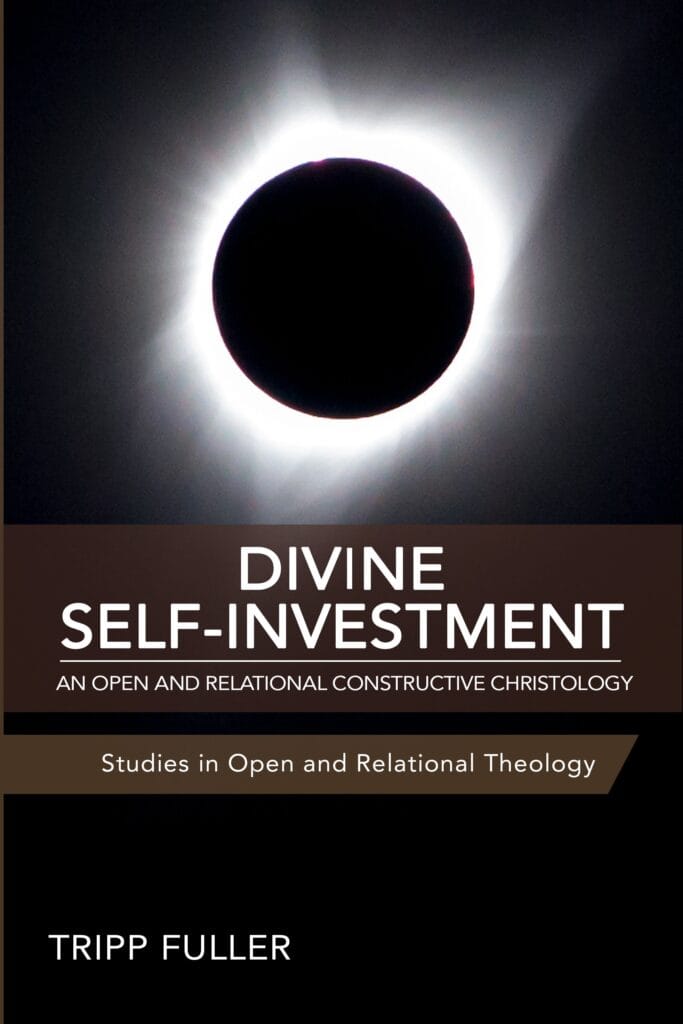
Divine Self-Investment: An Open and Relational Constructive Christology
- By Tripp Fuller
- August 17, 2020
- SacraSage Press
When muttering the word “God” doesn’t come easy, what does it mean to call Jesus “the Christ?” Fuller offers a robust constructive Christology that engages three theological registers – historical, existential, and metaphysical.
Beginning Christology not from above or below but from within the Disciple’s confession of Jesus as the Christ, Fuller constructs a powerful Open and Relational Christology. At the heart are three pairings of contemporary thinkers who share a thematic center with distinct trajectories. Fuller weaves each into a vision of God’s self-investment in history and the person of Jesus. The constructive proposal not only uses an Open and Relational vision but reshapes it in light of God’s self-investment in Christ. The significance of Fuller’s proposal is wide-reaching, engaging revelation, divine power, evil, the cross, hope, the imago dei, and the Spirit.
- Get a Copy of Divine Self-Investment: An Open and Relational Constructive Christology
About the Author(s)

Tripp Fuller is an American theologian, minister, and broadcaster. He is the founder and host of Homebrewed Christianity, one of the most downloaded theology programs in podcasting. Tripp earned his BA at Campbell University, his MDiv at Wake Forest University, and his PhD in Philosophy, Religion, and Theology at Claremont Graduate University. He is currently a Postdoctoral Research Fellow in Theology and Science at the University of Edinburgh, and the author of Divine Self-Investment (SacraSage Press, 2020).
More Books