

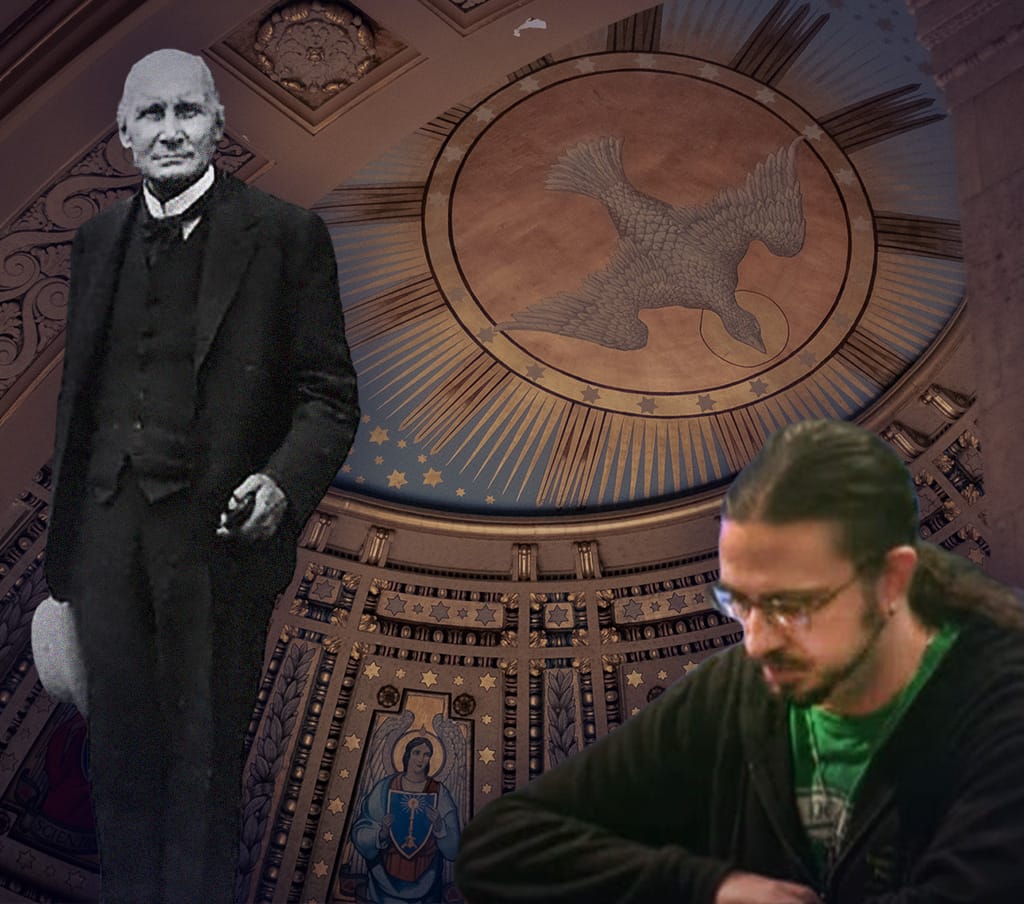
The following article was originally published on the Letters from the Eschaton Substack by Jonathan Cobb. Reposted with permission.
It’s been just over a year since the passing of my grandfather, John B. Cobb, Jr. It’s quite a thing to grow up with a grandfather so widely renowned. He wasn’t celebrity famous—it’s not like ordinary people would recognize him walking down the street—but he was highly influential and well-regarded in his field of theology, and well outside of it as well, expanding into fields such as ecology and economics. In the last couple decades of his life, thanks to an enthusiastic Chinese student named Zhihe Wang, he gained a huge foothold in China. It’s rather an unusual predicament for a Christian theologian to be embraced by the atheistic Chinese Communist Party, but of course it wasn’t his views on God that concerned them, but rather his views on ecology. He helped establish 36 Process Centers in China and played a pivotal role in developing the CCP’s project of “Ecological Civilization.” The Chinese knew him as “Eco Sage.”
The thing is, my grandfather was not what you’d call a Biblical theologian. His theology did not involve a lot of scouring scripture for insight, though he did write a commentary on the Book of Romans. He was a philosophical theologian, applying metaphysics to the Christian faith, and his metaphysics came from the early 20th century theologian Alfred North Whitehead.
Whitehead is perhaps best known for his work with Bertrand Russell on the Principia Mathematica, a seminal work in Analytic philosophy seeking to ground mathematics in logic. Its arguments are largely considered obsolete by modern logicians, but they demonstrate Whitehead’s masterful grasp of both mathematics and logic.
Whitehead, however, had a larger vision. Drawing on the vitalism of Henri Bergson, the pragmatism of William James and C. S. Peirce, and the empiricism of John Locke and David Hume, he developed a systematic metaphysics of process. For him, there are three ultimate categories: God, the world, and creativity. Curiously, he pictured creativity as ontologically prior to God, as something that both God and the world partake in. He challenged the traditional view of God as outside of time, instead positing him as an active participant in it.
For Whitehead, time is atomic. It is composed of temporal atoms called “actual occasions,” which are effectively snapshots of the total relations between entities in the universe at any given time. These entities are subordinate to their relation. So if I am in the kitchen drinking tea, it is not “Jonathan (subject) drinks (verb) his tea (predicate) in the kitchen (setting).” It is more a state of affairs consisting of “Jonathan-drinking-tea-in-the-kitchen.” For Whitehead, all phenomena are internally related, meaning they are mutually constitutive. Objects like tables or rocks or people like you or me are, as it were, abstractions from collections of actual occasions, which Whitehead calls “societies” of occasions. The ultimately real things in the world are these snapshots of existence known as actual occasions.
Each actual occasion is born, persists, and then perishes as it informs the next actual occasion, which is infused with novelty by an “initial aim” given to it by God. God in this scheme does not create the initial aim ex nihilo but orders it from a set of possibilities offered by Creativity. God, in other words, performs a reductive function for Creativity and a persuasive function for the world. This is the “primordial nature of God,” in which he creates through persuasion. When an actual occasion has perished, it is preserved in its presentational immediacy through the “consequent nature of God.” In this way, the past persists and nothing is ever truly lost.
I’ve gone on quite a diversion here and there is more that could be said, but since I am going to level a critique at a thinker whose thought is quite complex and profound, I hope to convince any Whiteheadians out there that I am in fact familiar with the source material. Between my brother and my cousins, I was the only grandchild to dive into this stuff and take a keen interest in my grandfather’s work. I was initially drawn to it through the work of Ken Wilber, but found greater rigor and sophistication through Whiteheadian philosophy. From there I became interested in James, Peirce, Bergson, Deleuze, Hegel, and so much more. My grandfather’s work was a springboard into a much wider pool of philosophy.
Curiosity can be dangerous, however, and in my philosophical explorations, I began to find certain aspects of Whiteheadian thought unsatisfying, and started developing a critique of them. At the same time, I was undergoing a transformation in my faith. My grandfather’s theology is very much on the liberal side of the spectrum, showing little care for dogma or tradition. Meanwhile, at the same time I was becoming more politically radicalized, I found myself becoming more theologically conservative. I eventually became confirmed into the Roman Catholic Church, and in the process learned to treat tradition with greater reverence in my theology.
In the first part of this essay, I will lay out my areas of agreement with Whitehead. Whatever my quarrels, I still have great respect for the Whiteheadian project, and see many valuable contributions worth preserving. In the next section, I will lay out my philosophical disagreements with Whitehead’s metaphysics. In the following section, I will address my theological issues with process theology, and advocate for a view that, while not strictly orthodox, lines up more faithfully with the traditional teachings of the church. Finally, I will attempt to sketch an outline of my own metaphysical views, which preserve what I find valuable in Whitehead while differing on a few crucial points in a way that I believe allows me to address similar philosophical problems in a more harmonious way.
Points of Agreement
Whitehead’s process ontology seeks to accord a special place to creativity. In contrast to materialistic accounts that see a cosmos consisting solely of efficient causation and material necessity, Whitehead sees a cosmos that gives rise to genuine novelty. Along with this, he sees a role for true freedom. The future, for him, is causally open—something we co-create through our decisions. He extends this agency all the way down, such that each subatomic particle prehends its environment and exercises some agency in its own becoming. This doesn’t mean everything is conscious per se, but that there is a core element of experience and even agency at the heart of the cosmos, in which all things partake in the creative becoming of the universe.
I agree with the spirit of what Whitehead is gesturing toward here, even if I quibble with some of the details. Whitehead is of course not the first philosopher to give novelty and emergence a special place in their system. Heraclitus saw flux as the most fundamental fact of nature. Hegel saw a dialectical tension between terms in which thesis and antithesis led to a newly emergent synthesis. Henri Bergson saw time as pure duration, which we only divide into increments in retrospect. More recently, Gilles Deleuze saw novelty unfolding through a repetition of difference. And now the science of complexity theory is showing how emergence is mathematically structured at the very heart of our reality.
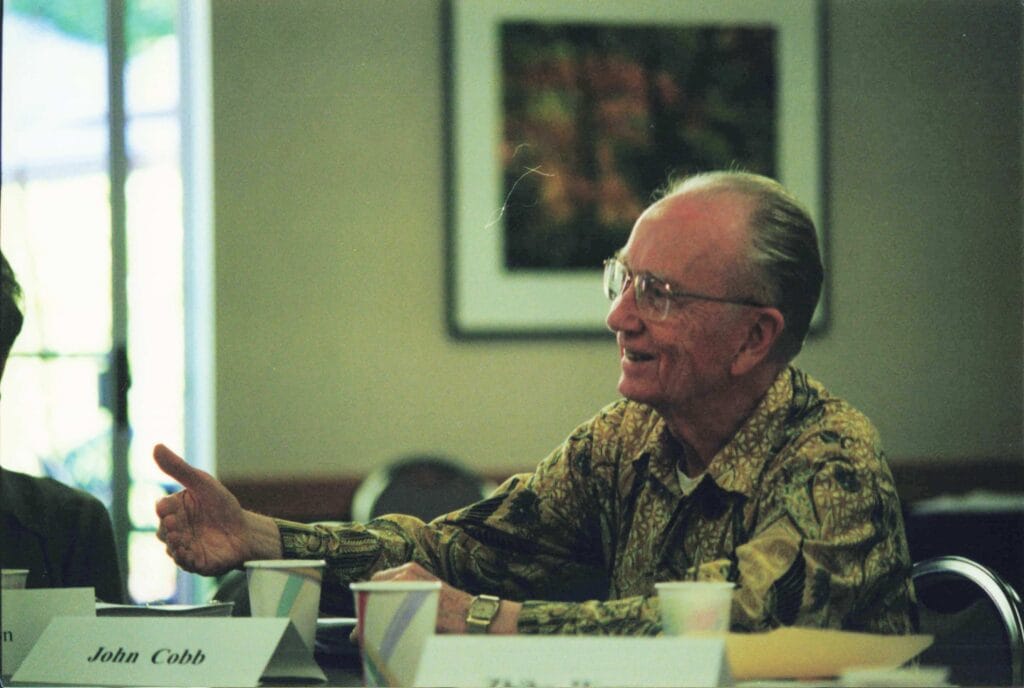
John B. Cobb, Jr. at Center for Process Studies conference on religious pluralism, March 2003
In truth, I must say Bergson has been a bigger influence on my thought than Whitehead. His account of memory as the embodied perception of duration has been key to a lot of my ideas. But one thing that Whitehead’s thought brings to the table that Bergson does not is an ecological focus. The Bergsonian emphasis on time as flow is replaced in Whitehead with a scheme of internal relations in which “The many become one, and are increased by one” (Process and Reality, 21). The mutual constitution and dynamic interaction of entities is central to systems theory today. It is my conviction that the science of the future must be ecological, systemic, and dynamic, much like Whitehead’s philosophy.
Whitehead’s philosophy sees value as something really existing in the cosmos. He once remarked that “Scientists animated by the purpose of proving that they are purposeless constitute an interesting subject for study” (The Function of Reason, 16). The mechanistic paradigm of scientific materialism renders us aliens in a cold, dead world in which our experience of it is a freak anomaly and the perception of value is at best a subjective epiphenomenon and at worst an illusion. For Whitehead, on the other hand, experience is something primary to the cosmos and the most fundamental experience is that of value. Value is something actually realized in the world, and the advance of creativity is the creation and realization of greater value.
Philosophical Objections
Among Whitehead’s more enduring contributions to philosophy is his concept of the “fallacy of misplaced concreteness,” a type of reification in which one treats a concept as if it has causal agency. We may say, for example, that gravity causes an object to fall, or evolution causes an organism to adapt to its environment, when in fact these are concepts invented to explain the very phenomenon being described. On reading Whitehead, however, it seems to me that he commits what I’d call “the fallacy of excessive concreteness.” The actual occasions he describes are pure concreteness in a similar vein to the “atomic facts” described by the early Wittgenstein. It is an elegant system of pure relationality undergoing concrescence—and utterly alien from the world of experience. The world in which I am a subject interacting with objects becomes one in which “I” am part of a series of snapshots that also include the objects and my interacting with them. The sense of distinct identity and continuity of these entities is an emergent abstraction. Whitehead expresses this by advocating a “becoming of continuity” rather than a “continuity of becoming.” It is not too dissimilar to what Buddhists describe as “emptiness.”
It is not that I think Whitehead’s perspective here is wrong so much as partial. I am in some sense constituted by my relations, yet I have a capacity to relate to things in certain ways and not others. As a human, I have a specific body constitution that allows me to eat certain foods and not others, inhale oxygen and exhale carbon dioxide, have a certain tolerance for heat and cold, and have a certain capacity to socially interact with other members of my species in ways that I can’t interact with other species. As an individual, I have a personality, a particular set of tastes, and a particular point of view. I will relate to certain people as friends, others as enemies, a select few as lovers, and how I relate to them will be a matter of both my nature and theirs, and others with their own different nature will relate to them in other ways. In other words, there is within me a certain capacity to relate in ways that are unique to me, that spring forth from some inner nature of mine. One may, of course, readily point out that this nature is not fixed and eternal, but a result of a particular set of circumstances of my life, from the genetic material that came together to make me to the family environment I grew up in to the set of experiences I had thereafter.
I might counter that there is some particular way I reacted and responded to those experiences that someone in the same situation would not have, but no matter, because what we have here, contra Whitehead, is a continuity of becoming. There is an irreducible thisness to what is undergoing change as it enters into different sets of relations. There is an irreducible thing that is doing the relating. I can think of no better term for this than “substance.” Whitehead’s philosophy is in large part a systematic polemic against substance ontology. The baroque set of concepts he invents all serve to articulate a comprehensive ontology that replaces substance with atomic events.
He is not the first philosopher to attempt to do so. David Hume attempted to replace substance with “bundle theory,” in which what we perceive as distinct substances are really just bundles of qualities that we associate through habits of thought. Where these habits of thought arose from and why they were so consistent for what were supposed to be arbitrary associations was left unsaid. For Whitehead, the becoming of continuity involves an “inheritance of the past,” in which past occasions are inherited by the new actual occasion in its process of becoming, thereby establishing a chain of continuity. But if the past is a total set of internal relations, how is there this canalizing of occasions such that I have my personal history and you have yours? How does this happen unless there is a selectivity of relations, in which some relations are more relevant to one individual than another? And how can that relevance be determined for that individual if they are not in fact a discrete individual—in other words, a substance? Buddhists would describe what I am referring to as “relative truth,” in contrast to the “absolute truth” of emptiness. My only gripe with this would be the implied subordination of the one to the other. The one perspective is as real and relevant as the other, and each reveals important things that the other does not.
If substance seems less “real” to Whitehead, it is only because it is less concrete. Substance is properly virtual. It is not a particular quality or relation, but that from which these qualities and relations spring. It is a kind of nothingness by which an entity exists. In this sense, Buddhists are right—beneath all surface phenomena lies emptiness. But it is a productive emptiness—a virtual field of continuous arising. And it is a nested field of such fields. At the ultimate level is the field of reality itself, and then a chain of subordinate fields, each whole unto itself, existing within a larger whole, and containing its own subordinate fields. Our own bodies contain organs which contain cells which contain organelles and so on. The universe is a continuous process of producing new fields, or what we might call substancing.
Theological Objections
Whitehead’s system had God as a central component, but his God differed markedly from the God of traditional Christian theology. He believed religion had a constructive role to play, and praised Christianity at times, but he was not particularly concerned with reconciling his system with Christian theology. That work was pursued by Process Theology, which my grandfather played a central role in creating. Process Theology applies the God of Whitehead to Christianity and sees it as offering a more robust and rationally defensible system than what it calls “Classical Theism,” which essentially means all Christian theology prior to the 20th century, or if we’re being generous, prior to Schliermacher. When I first got into Process Theology, it was the sense that it could fit more easily into a rational scientific worldview that drew me in. However, I am a curious person by nature, and eventually I felt the need to look into this maligned “Classical Theism” myself and see what the deal was.
One central aspect of Process Theology is its critique of omnipotence. It sees the God revealed in the Gospel as one of persuasion rather than coercion. It contrasts the persuasive power of Christ with the coercive power of Caesar, and critiques theologies that attribute this coercive power of Caesar to God. But it doesn’t take this as merely a commentary on the character of God, but a limitation on his abilities. For Process Theology, God can’t force things to happen, but rather requires the participation of creation. In this way, it claims to answer the Problem of Evil. Does a person die of cancer in spite of their prayers because they’re bad? Because it’s all part of God’s plan? For Process Theology, God would very much like to heal them but is unable to do so. What the Whiteheadian God does offer is empathic connection. Whitehead describes God as “the fellow-sufferer who understands” (Process and Reality, 351). God is responsible for the ordering of possibilities and in that sense does intercede, but cannot do so without limit.
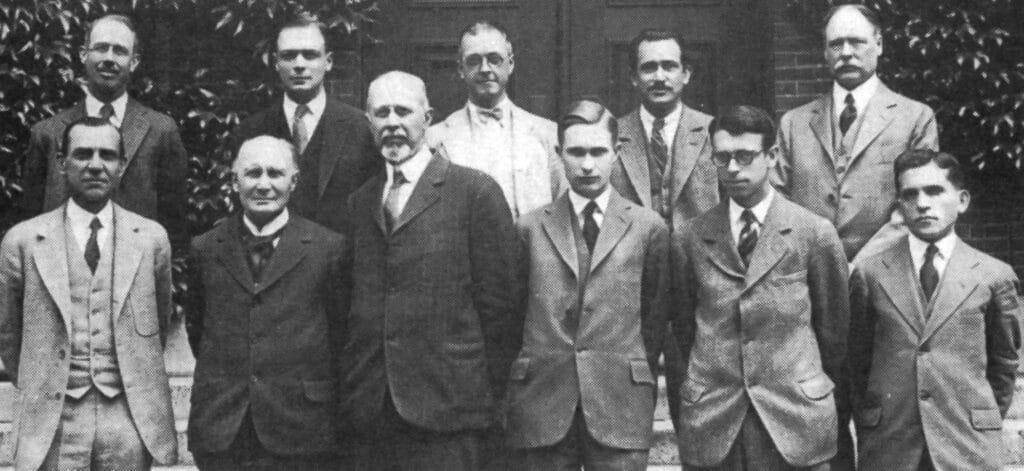
Alfred North Whitehead (front row, second from left) and his colleagues at the Harvard Department of Philosophy in 1929, the same year as the publication of Process and Reality
I am a bit more sympathetic to the question of the image of God invoked by omnipotence. The Gospels go out of their way to contrast Christ and Caesar, and we should be wary of remaking God in Caesar’s image. Process Theology therefore offers a Gandhi-like image of God as passive, persuasive, non-violent. But are Gandhi and Caesar the only options? What of Che Guevara—one who is willing to use force in the service of liberation? Is that not the God who drowned Pharaoh’s army? It is true that Christ in the Gospel shows a path of kenosis, in which force is met with mercy, but the notion that he rejects force altogether is to misunderstand his mission. He was deeply engaged in spiritual warfare against the Powers and Principalities of this world. His multiple exorcisms and healings, driving out the money-changers, and ultimate sacrifice on the cross, were all part of an apocalyptic battle with the forces of darkness.
I can certainly understand and sympathize with the notion that omnipotence is a problematic concept. It gets into tiresome debates such as whether God could create a stone so heavy that he himself could not lift it. There are numerous fruitful replies to such logical puzzles, suggesting that omnipotence does not cover logical impossibilities, and more crucially, must adhere to contingencies, such that whatever God does in the world will necessarily entail effects in other parts of the world, and God’s will can only be understood in terms of the total effect, much of which is obscure to our finite perspective. So I am not so eager to abandon omnipotence as such, provided it has such qualifiers, but I am also not so eager to insist upon it, given such misunderstanding and confusion as it is prone to create. What I would say, however, is the Process critique of omnipotence gets us no closer to answering the Problem of Evil. We know, for example, that some people do make a miraculous recovery from cancer while others do not. Are we to infer that God was capable of curing the one person and not the other? If so, how are we to know where God’s capabilities lie? Are we left with any less mystery than God choosing to spare the one but not the other? Unless we are willing to retreat into pure Deism, divine intervention will necessarily entail the mystery of its selectivity.
What I am willing to say is that God’s power is of a different nature than the power we are accustomed to. If anything, it is we who have a fallen understanding of what true power is. The kind of power we imagine ourselves having if we were God involves snapping our fingers and making things happen instantly. If history is any indication, this is not how God works. God works on a much longer timescale. He sets events in motion whose effects only become apparent to us in retrospect. My own faith journey has been one of recognizing the hand of grace and providence throughout my life. I have often found myself reflecting on where my life has taken me, and realized that some prayer has been answered. However, it is usually answered over a much longer period of time than I’d hoped, and often in unexpected ways. When I have felt the hand of the divine manifest instantaneously, it is usually not an answer to prayer so much as a karmic lesson. God works on his own time.
Speaking of time, Process Theology is rather unique in conceiving of God as purely within time. It posits a God who is affected by events in the world, and therefore experiences those events with us in real time. It is important to Process Theology that this affectivity is univocal—God experiences our joys and sorrows in the same sense that we experience them. Moreover, just as Process Theology denies omnipotence to God, so too do they deny him omniscience by making him ignorant of the future just as we are. God, in this scheme, may have more information to predict the future, but he does not know the future any more than we do because the future is contingent on the free choices of beings such as us.
Such concerns were deeply familiar to Church Fathers such as Augustine who, nonetheless, insisted upon the eternity of God. For Augustine, and for theologians who followed him, God is outside of time, perceiving all moments in their immediacy. This in no sense contradicted free will, for our free choices are as much a part of God’s providential plan as are God’s choices. It is not that God knows ahead of time what you are going to do, because “ahead of time” is still to place God within time. For God to be outside of time means that he experiences all time simultaneously: he experiences the time before, during, and after you make a decision as if they were a single moment. The Whiteheadian framework seeks to preserve a sense of freedom and creativity that seems threatened by such notions of eternity, but in truth, no such threat exists.
Furthermore, it is my contention that Whitehead’s own framework leads to exactly this conclusion that it seemingly resists. For according to Whitehead, every actual occasion is preserved by God in its presentational immediacy. This means that every decision you have ever made is preserved as if you were making it in the present moment. So too is the present moment preserved in some future moment. Which means that God in the future will have preserved this present moment as it is occurring now, with the free choices you make within it. Which is functionally the same as saying that a future which for us is undecided already exists within God.
One doctrine central to Christianity with which my grandfather quibbled is the doctrine of the Trinity. I always figured this was some idiosyncrasy of his, and there have been Process Theologians who have defended some version of the Trinity. But the more I think about it, the more I realize Process Theology inherently lends itself to a kind of Arianism. For if God is within time, then that means the Father’s generation of the Son and the Holy Spirit occurred within time, and they cannot be co-eternal. There is an implicit subordinationism involved. The Trinity must transcend time or it is no Trinity at all.
Christianity is a religion of paradox. It follows Christ who is both God and Man, a God who is both immanent and transcendent, within and outside of time. It is about faith and works, free will and predestination, this world and the next. Process Theology, and liberal theology in general, tends to inhabit an overly rationalistic space in which these paradoxes are explained away, often by taking one side or the other. My grandfather would say that he is fine with paradoxes but doesn’t think we should go about inventing them. But these paradoxes were “invented” not by some idle philosopher but an early church grappling with the life and nature of Christ. And herein lies one of my fundamental differences with him. My Christianity is apostolic. I stand by the belief that the faith passed on through Christ’s apostles was guided by the same Holy Spirit that possessed them upon the church’s formation at Pentecost. This does not mean it has been right about everything, but that its development of doctrine has been guided by the God that it worships.
Whitehead’s philosophy is heralded as a philosophy of time, but in practice it is often just a philosophy of novelty. The temporality of tradition is all too often ignored. Tradition turned stagnant and obstinate is dead, but a living tradition remains in continuous conversation with its past. It does not make a sudden rupture with all hitherto theology by deriding it as “Classical Theism,” but looks to the past for insight into the present and attempts to see where that tradition might be developed to remain relevant in a changing world.
Where I Stand
I owe a great intellectual debt to Whitehead, to Process Theology, and to my grandfather, but I can no longer accept their conclusions. What I wish to preserve from this tradition is a sense of creativity, emergence, of value as something real in the universe, and of ecological interconnection of all things. But since I find myself at an impasse with so much of Whitehead’s system, I have had to develop my own philosophical system, to which I cannot give sufficient space here, but hope to provide a brief sketch.
Central to my philosophy is the Logos, that order by which all things live and move and have their being. The Gospel of John informs us that Jesus himself is this Logos made flesh. The Logos underlies the rational order to the cosmos that allows us to understand it through mathematics, science, and reason. The science of complexity theory in particular reveals how this order is hard-wired to generate novelty and emergence. Each emergent phenomenon produces what Stuart Kauffman calls the “adjacent possible,” a phase space of possibilities it can actualize. With each possibility that is actualized, a new adjacent possible opens up, leaving the universe causally open and in Kauffman’s words “partially lawless.” In this way, the ordering of possibilities that Whitehead assigns to God is immanent within every emergent entity.
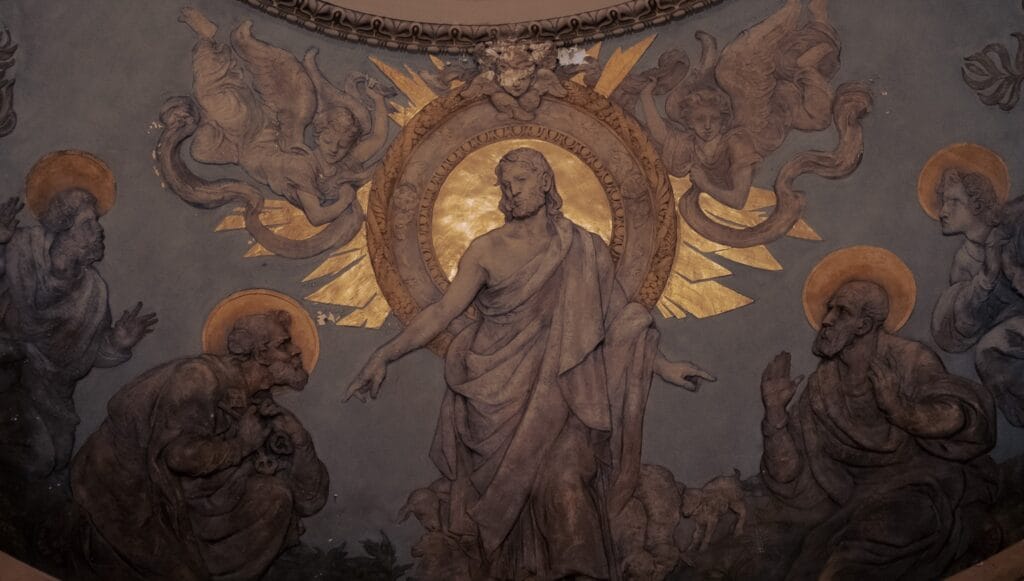
Relief sculpture of the resurrected Christ at the Cathedral of Saint Paul in Minnesota
This immanence within entities means taking them seriously as entities, reducing them neither to constituent parts as reductionist materialism does nor to their relations as Whitehead does. Graham Harman calls these tendencies “undermining” and “overmining.” Of course, insisting on every object being discrete leads to its own mereological problems as well, such as identifying how many distinct clouds are in the sky. But it is less important to clearly identify discrete objects than to recognize that the cosmos has both continuities and discontinuities, connection and discreteness. The Logos is in a constant process of substancing by producing discreteness. Novel formations emerge within the context of a greater whole differentiating itself (or differenciating, to use Deleuze’s terminology). It produces wholes within wholes within wholes.
Time is both discrete and continuous, presentist and eternalist. As J. T. Fraser observed, there is a hierarchy of temporalities operating at different scales, from the atemporal to the sociotemporal. Edith Stein posited that angels exist in a temporality greater than ours but less than God. She also suggested that when our time on this earthly plane is done, we transition from a temporal to an eternal state, renewed in God and yet returning to what we always were.
At the core of reality is frequency, harmony, and rhythm. From the mass of particles to the firings of neurons in our brains, all things operate on frequency. The ancients called this “universal music”—musica universalis—or the “harmony of spheres.” All entities exist as a certain frequency, and their relation to other entities is based on resonance. We exist within a certain shared frequency of reality with all that we encounter, yet we have our own unique frequency within this shared reality. Through art we seek to depict something that resonates with something within us. Through music we seek to resonate with a common frequency. Through ritual we seek to attune ourselves to the frequency of something greater than ourselves.
At the core of reality is frequency, harmony, and rhythm. From the mass of particles to the firings of neurons in our brains, all things operate on frequency. The ancients called this “universal music”—musica universalis—or the “harmony of spheres.” All entities exist as a certain frequency, and their relation to other entities is based on resonance. We exist within a certain shared frequency of reality with all that we encounter, yet we have our own unique frequency within this shared reality. Through art we seek to depict something that resonates with something within us. Through music we seek to resonate with a common frequency. Through ritual we seek to attune ourselves to the frequency of something greater than ourselves.
I am sure Whiteheadians will have their own responses to my objections, and I am certainly receptive to them, though I anticipate that on some things we will find ourselves at a stalemate. No matter. I certainly hope they will not hold it against me, as I find Whiteheadians as a whole to ask interesting questions and discuss novel ideas, and I would hope to continue to be part of that conversation.
Works Cited
Whitehead, Alfred North. The Function of Reason. Boston: Beacon Press, 1971 [1929].
Whitehead, Alfred North. Process and Reality. Corrected edition. Edited by D.R. Griffin and D. Sherburne. New York: The Free Press, 1978 [1929].