The inaugural Mind-at-Large Project conference, A New Dawn, was held online from April 15–17, 2026, bringing together scholars, researchers, and practitioners from across philosophy, science, religious studies, and consciousness studies for a multidisciplinary exploration of consciousness and its place in nature.
The conference was co-organized by the Mind-at-Large Project team: Andrew M. Davis (Center for Process Studies), Peter Sjöstedt-Hughes (University of Exeter), Matt Segall (California Institute of Integral Studies), Elly Vintiadis (American College of Greece), Àlex Gomez-Marin (Institute of Neurosciences, Alicante), Jared Morningstar (Center for Process Studies), and John Buchanan (Center for Process Studies).
Designed in response to what many perceive as a shifting intellectual landscape, the conference created space for rigorous dialogue across diverse perspectives, including philosophy of mind, neuroscience, cosmology, religious studies, process thought, and experiential research. As noted in the opening session, the theme—A New Dawn—was chosen to reflect a broader transition in contemporary thought: a sense that the sun is now rising on new perspectives concerning the primacy and extent of consciousness in nature, even as it begins to set on more strictly reductive, mechanistic, and materialistic accounts.
Over the course of two and a half days, the program featured plenary lectures, Emerging Perspectives sessions, and panel discussions. Across three days, the conference asked whether consciousness is best understood as a late product of brain activity or as a more fundamental, relational, and perhaps cosmic dimension of nature.
Day 1: Framing
Opening Mind-at-Large Talk
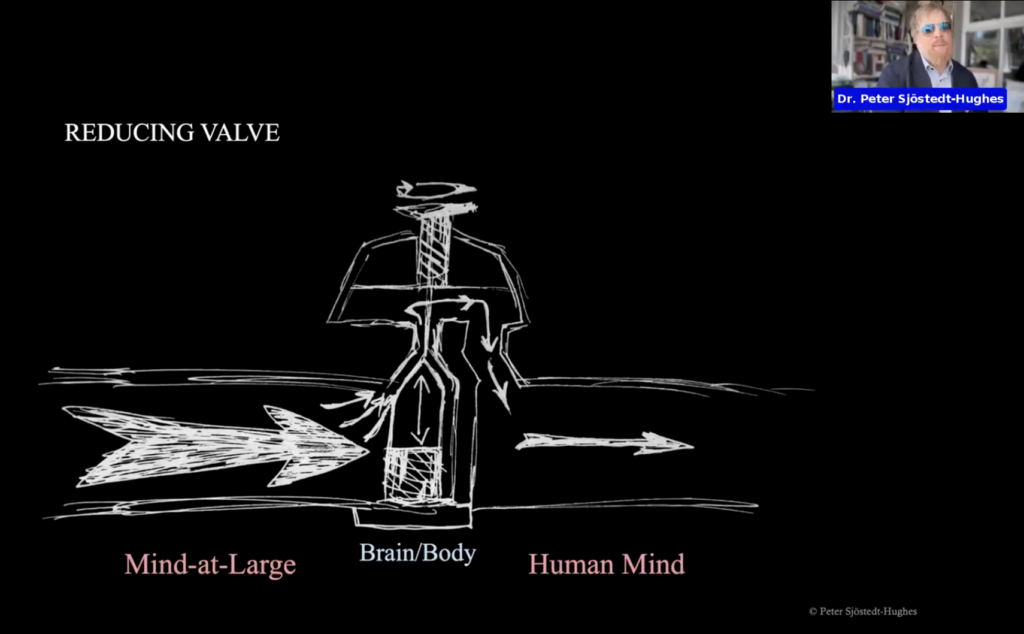
The conference opened on Day One with Peter Sjöstedt-Hughes’ Mind-at-Large talk, “Mind-at-Large: Etymology and Cosmology.” Peter traced the phrase “mind-at-large” from Aldous Huxley’s The Doors of Perception back to Henri Bergson’s philosophy of mind, perception, and memory. In this lineage, “mind-at-large” names the idea that consciousness is not produced by the brain so much as filtered or constrained by it. Peter developed Bergson’s “reducing valve” model, according to which the brain canalizes consciousness toward practical action by narrowing the vast field of perception and memory. Bergson’s formulation, that “the state of the brain exactly corresponds to perception, but it is neither its cause nor its effect, but merely continues it,” served as one of the conceptual touchstones of the conference.
Plenary Lectures
Day One’s plenary speakers were Philip Goff, Curt Jaimungal, and Àlex Gomez-Marin. Philip Goff’s presentation on rational mysticism explored how panpsychism might interpret psychedelic ego-dissolution experiences, especially those occasioned by 5-MeO-DMT. He asked whether such experiences should be treated as hallucinations, veridical disclosures, or something more ambiguous: experiences that may be metaphysically suggestive without being automatically authoritative. Curt Jaimungal offered a typology of irreducibility, including compositional, conceptual, reflexive, and computational forms, and suggested that consciousness may require a kind of “averted vision”: it cannot be directly objectified without being missed. Àlex Gomez-Marin reframed the hard problem of consciousness as “the covering up of a crime scene,” challenging participants to consider whether materialist assumptions rule out in advance the very phenomena most in need of explanation.
Panel Discussion
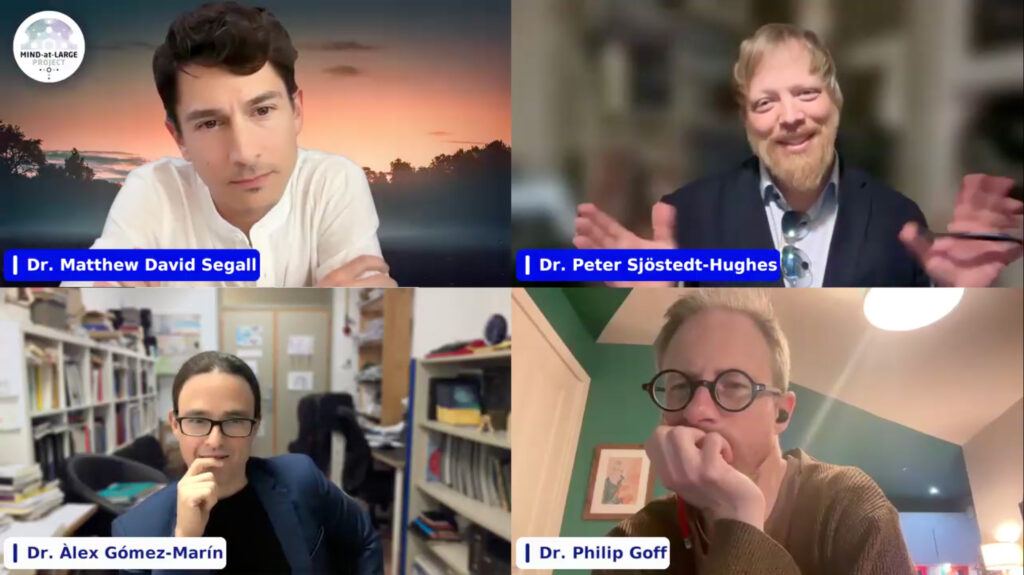
The Day One panel brought Philip Goff, Peter Sjöstedt-Hughes, and Àlex Gomez-Marin into conversation, moderated by Matt Segall. The discussion centered on how, if at all, minds can be changed about consciousness and materialism. A recurring question was whether logical argument is sufficient to shift ontological commitments, or whether transformative experience, historical contextualization, and community are equally necessary. Peter proposed a threefold approach: intellectual examination, historical recovery, and empirical evidence, including psychedelic research suggesting that altered states can shift metaphysical intuitions. Philip emphasized the importance of changing the broader intellectual culture so that philosophical inquiry is no longer dismissed under the spell of scientism. Àlex argued that the task is less conversion than liberation: many clinicians, scientists, and scholars already have non-materialist intuitions or experiences but fear professional cost.
Emerging Perspectives
Day One also included two Emerging Perspectives sessions. The first, “Philosophy of Mind & Mind-at-Large Frameworks,” featured Ali Khalilian Najafabadi on brain-in-a-vat scenarios, Robert Pepperell on psychophysicalism, and Ayeh Kashani on autocosmology. The second, “Embodiment, Process, and Relational Cognition,” featured Pedro Brea on dehumanization and process metaphysics, Benjamin Dueck on electromagnetic resonance and the extended mind, and Keren Lucy Bester on smell as a form of simple physical feeling. These shorter presentations gave the opening day further philosophical and embodied specificity without displacing the plenary arc.
Day 2: Deepening
Opening Mind-at-Large Talk
Day Two opened with Jared Morningstar’s Mind-at-Large talk, “Islamic Visions of a Mind-Centric Cosmos.” Jared expanded the conference beyond the usual modern Western coordinates of consciousness studies, showing how Islamic philosophical and spiritual traditions offer sophisticated resources for thinking a cosmos in which mind, intelligence, and divine creativity are not late accidents but central features of reality. His presentation helped establish one of the day’s recurring themes: the question of consciousness cannot be separated from inherited metaphysical and religious imaginaries.
Plenary Lectures
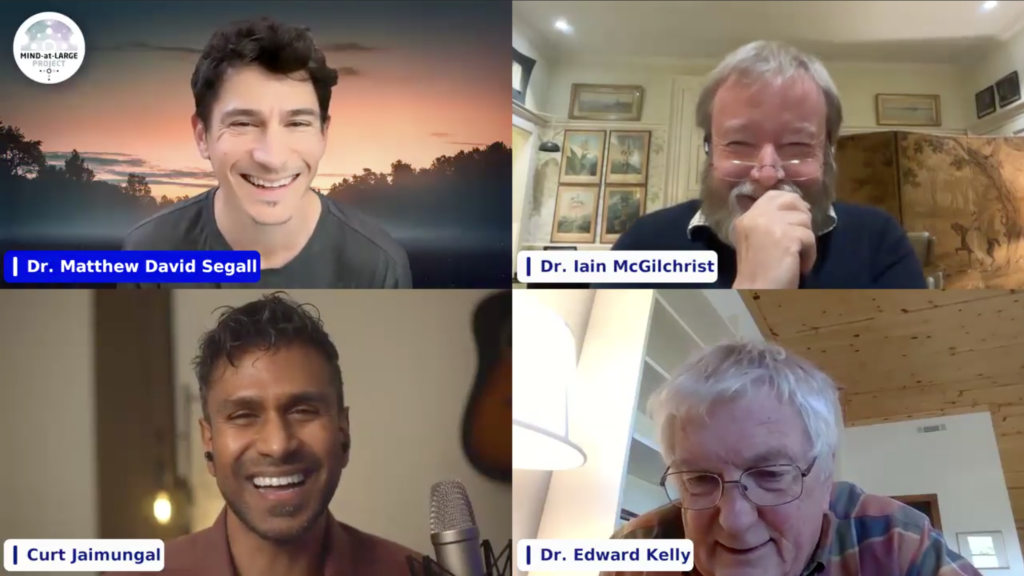
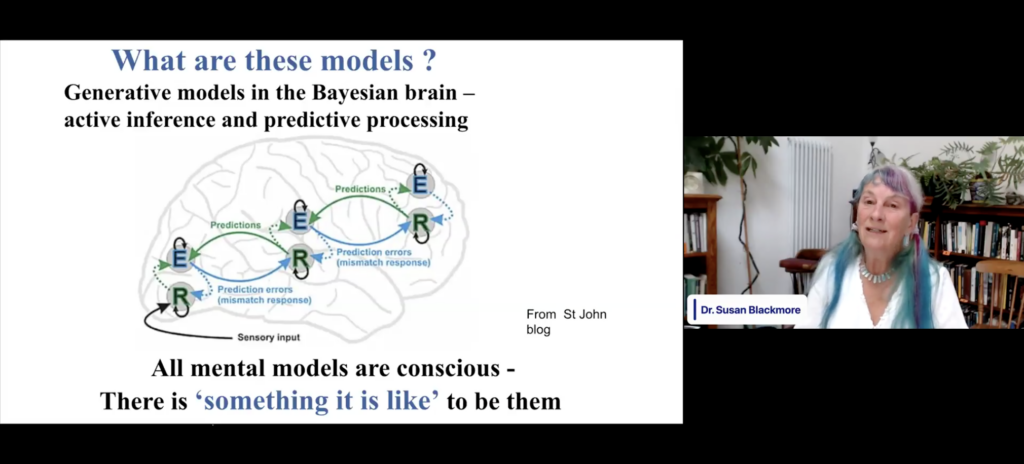
Day Two’s plenary speakers were Iain McGilchrist, Susan Blackmore, and Edward Kelly. Iain McGilchrist argued that relations are more real than the things we take to be related, and that reality is fundamentally creative, relational, value-laden, and conscious. His remarks drew on his broader account of the hemispheres, but the metaphysical claim was not merely neurological: the world is not built out of inert bits externally connected, but unfolds through living relations. Susan Blackmore provided a counterpoint by extending Helmholtzian, Bayesian, and free-energy approaches to selfhood. Reframing Nagel, she suggested that we cannot ask what it is like to be a bat, but we can ask what it is like to be a bat’s model of itself. Her presentation gave the conference a necessary test case for its more expansive metaphysical proposals, pressing the question of whether selves are substantial realities, models, processes, or useful fictions.
Edward Kelly’s plenary drew on nearly thirty years of collaborative research culminating in the Irreducible Mind book series. Kelly argued that physicalism remains the default metaphysics of mainstream science but is increasingly strained by evidence from psi research, near-death experiences, dissociative identity, psychophysical influence, genius, creativity, and mystical experience. He described early parapsychology as “a little rowboat out there in the North Atlantic trying to steer the Titanic away from the iceberg,” but suggested that the winds have shifted: developments in philosophy of mind, physics, psychedelic research, and consciousness studies are now generating convergent pressure against reductive materialism.
Panel Discussion
The Day Two panel, moderated by Curt Jaimungal, brought Iain McGilchrist, Matt Segall, and Edward Kelly into direct exchange around the question: what exists? McGilchrist emphasized relational creativity and the primacy of betweenness. Segall, drawing on Whitehead, described reality as a network or community of creative events, arguing that science is better understood as participation in reality’s disclosure than as detached representation of an external world. Kelly emphasized that “all that we really know anything about is experience,” suggesting that matter is a conceptual system abstracted from experience’s lawful patterns rather than the self-sufficient basis of experience itself. The panel converged on a rejection of both physicalism and solipsism, while opening toward some form of participatory, relational, dual-aspect, idealist, or process view.
Emerging Perspectives
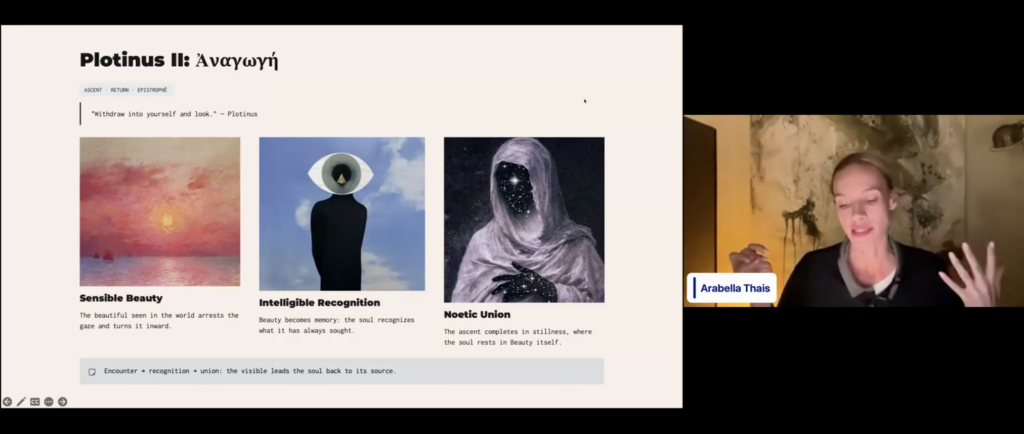
Day Two’s Emerging Perspectives sessions extended this relational and cosmological orientation. The first, “Biology, Semiotics, and Non-Human Intelligence,” featured Sam van Beljouw and Simon van der Els on the phenomenology of mobile genetic elements, Brian Tierney on astrobiosemiotics and the trickster dynamics of mind-at-large, and Iga Ogiejm-Oheim on cosmotechnics and the pluralization of individuation. The second, “Re-Enchantment, Aesthetics, and Cosmology,” featured Arabella Thais on beauty and the aesthetic intelligence of the cosmos, Kent Bye on astrology as a framework for panexperientialism, and William Rubel on Romantic poetry and the reactivation of speculative imagination. These talks expanded the conference’s scope beyond consciousness narrowly construed, bringing in organism, symbol, technology, aesthetics, and cosmic meaning.
Day 3: Synthesis
Opening Mind-at-Large Talk
Day Three opened with Matt Segall’s Mind-at-Large talk, “Human Consciousness in a Cybernetic Age.” Segall placed the mind-at-large framework in conversation with computation, artificial intelligence, and cybernetic models of cognition. His talk asked what becomes of human consciousness when thinking is increasingly modeled as information processing. Against the tendency to equate cognition with computation, Segall argued for a more participatory, historical, and organismic understanding of human intelligence.
Plenary Lectures
The Day Three plenary speakers were Andrew M. Davis and Elly Vintiadis. Andrew M. Davis turned the conference toward constructive process-relational and panentheistic models of consciousness. Drawing on Whitehead and the broader process tradition, he explored how consciousness might be understood within a metaphysics of creativity, relationality, value, and divine lure. Rather than treating God as an external supernatural agent, the process view interprets the divine as intimately involved in the becoming of the world: not coercive determination, but persuasive invitation toward richer forms of experience.
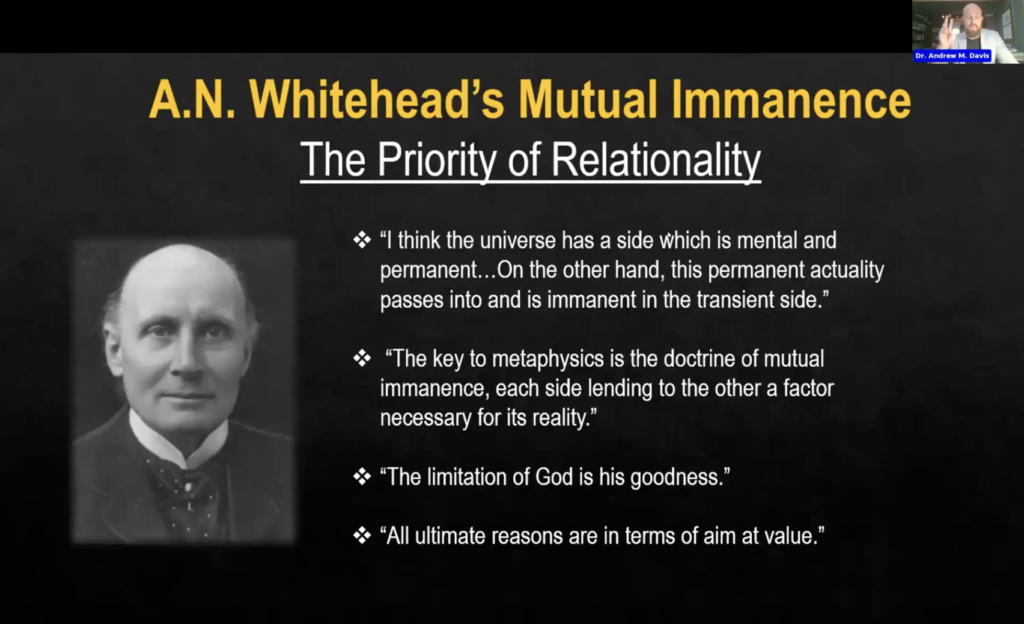
Elly Vintiadis’ plenary, “What Does Our Framework Allow Us to Know? Framework Privilege and Epistemic Injustice,” addressed one of the central methodological issues of the conference. Every framework reveals, but it also filters. It authorizes some forms of evidence while excluding others; it makes some questions askable while rendering others unintelligible. Her talk sharpened the conference’s concern with pluralism by showing that consciousness studies is not only a contest over theories, but also over whose experiences, methods, and forms of knowing are granted legitimacy.
Emerging Perspectives
The final Emerging Perspectives session, “Mysticism, Psychedelics, and the Extraordinary,” brought the experiential stakes of the conference into focus. Eirini Ketzitzidou Argyri examined psychedelic ontological shock as a doorway to mind-at-large; Alberto Cavallarin asked whether the noetic quality of mystical experience provides evidence for its reality; and Ada Kałużna compared the visionary experiences of Hildegard von Bingen and Philip K. Dick as instances of spontaneous epiphany. These talks pressed a recurring question from the whole conference: what kind of evidence is experience, especially when it transforms not only what one believes, but what one takes belief, selfhood, and reality to be?
Closing Panel Discussion
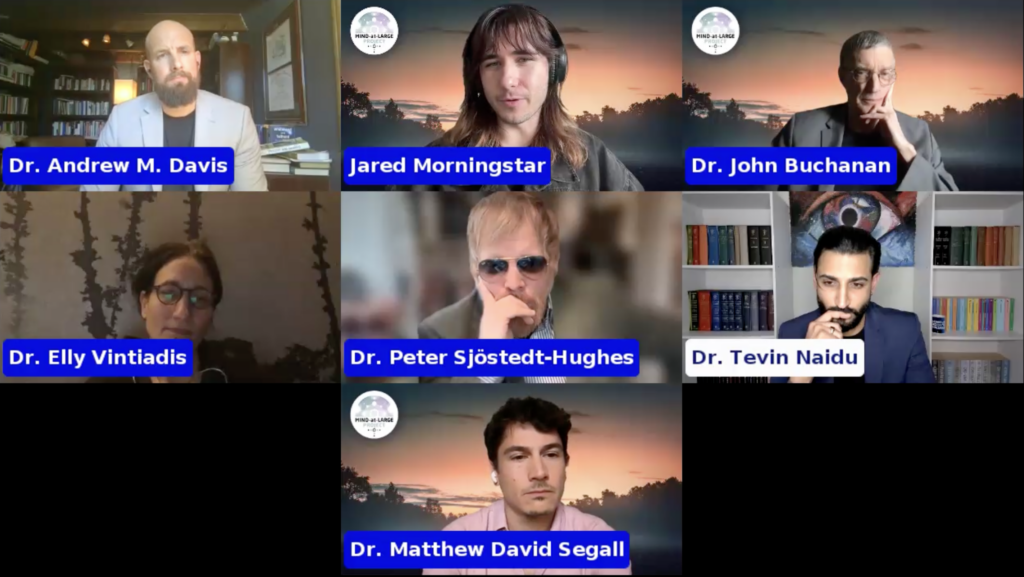
The closing plenary panel gathered Peter Sjöstedt-Hughes, Matt Segall, Elly Vintiadis, Jared Morningstar, John Buchanan, and Tevin Naidu, moderated by Andrew M. Davis. The panel did not attempt to resolve the problem of consciousness. Its achievement was more modest and more consequential: it clarified that the old physicalist settlement no longer satisfies a growing range of philosophers, scientists, clinicians, contemplatives, and scholars of religion. The conference treated “mind-at-large” not as a slogan, but as a provocation, an inheritance, and a research program.
The final sessions turned toward constructive proposals and future directions, including process-relational and panentheistic models of consciousness, as well as the possibility of developing more integrative frameworks capable of accommodating empirical findings alongside lived experience. Mike Murphy’s phrase “evolutionary panentheism” surfaced as a suggestive name for the central tendency of many of these alternatives, echoed in Myers’s line, quoted by Kelly, that “that which lies at the root of each of us lies at the root of the cosmos, too.”
Takeaways
Across the three days, recurring themes included the limits of physicalist explanation, the role of transformative experience in shaping theoretical commitments, and the challenge of integrating subjective and objective approaches within consciousness studies. Discussions also addressed broader institutional and cultural dynamics, including the marginalization of non-materialist frameworks and the need for more pluralistic methodological approaches. The conference was not anti-scientific. It was anti-constriction: a call for science and philosophy to become capacious enough for the full range of experience.
The Mind-at-Large Team have announced plans for more online events in the coming year, and an in-person conference in 2027 (with a hybrid online option to preserve the geographic inclusivity that made the inaugural event possible).
Supporting the Mind-at-Large Project
The Mind-at-Large Project is a multi-year initiative dedicated to advancing interdisciplinary research and dialogue on consciousness. If you found this conference valuable and would like to support future events, publications, and collaborative opportunities, we warmly invite you to consider making a contribution.
Looking Ahead
A New Dawn marks the beginning of the three-year Mind-at-Large Project dedicated to advancing interdisciplinary research on consciousness. While this inaugural conference was held online, the organizing team is actively planning future events, including potential in-person gatherings.
We strongly encourage participants and attendees to remain engaged with the Mind-at-Large Project initiative as it continues to grow. Additional conferences, publications, and collaborative opportunities will be announced in the coming months, and we look forward to continuing these conversations together.
To help us improve and to stay connected, please make use of the following resources:
On behalf of the Mind-at-Large Project team, we extend our sincere thanks to all speakers, participants, and attendees for contributing to the success of this inaugural conference.