
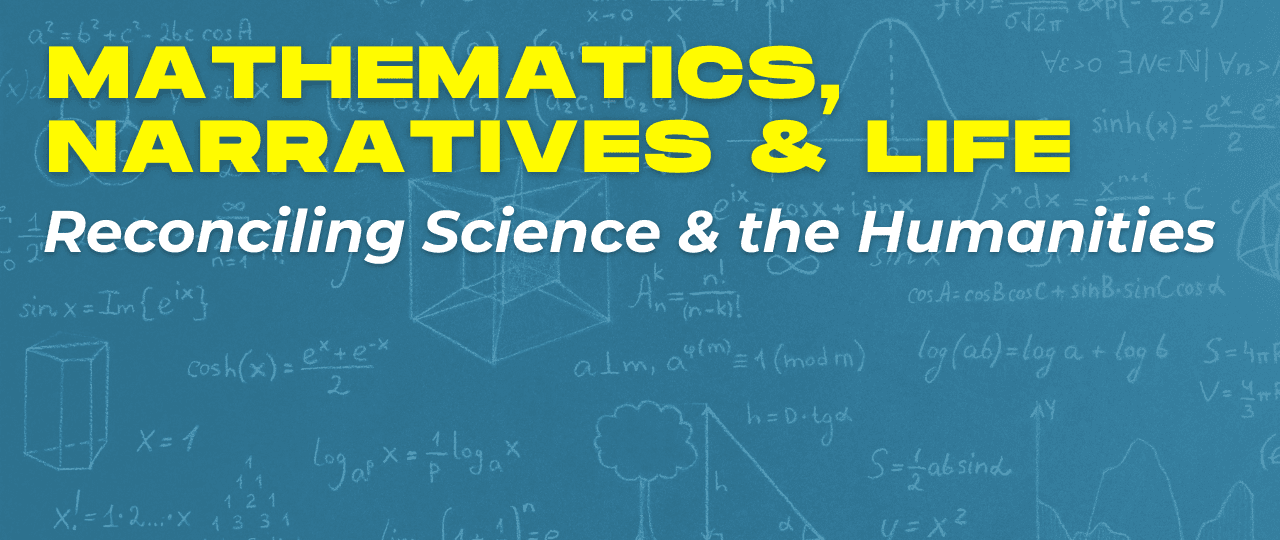
The triumph of scientific materialism in the Seventeenth Century not only bifurcated nature into matter and mind, as Whitehead pointed out. It divided science and the humanities. The core of science is the effort to comprehend the cosmos through mathematics. The core of the humanities is the effort to comprehend history through narratives. The life sciences can be seen as the zone in which the conflict between these two very different ways of comprehending the world collide. Evolutionary theory developed out of natural history as defended by Schelling, but efforts have been made to formulate neo-Darwinism through mathematical models. However, it is impossible to eliminate stories from biology. As Stuart Kauffman pointed out, mathematical models attempt to pre-state all possibilities, but in evolution there can be adjacent possibles that can be embraced by organisms but cannot be pre-stated. To account for these it is necessary to tell stories.

Mathematics provides analytic precision allowing long chains of deduction, but tends to deny temporal becoming and cannot do justice to the openness of the future, while narratives focus on processes and events, but lack exactitude that would allow precise deductions. In advancing mathematics adequate to life, Robert Rosen argued that living beings as anticipatory systems must have models of themselves, and strove to develop a form of mathematics able to model this. It has been convincingly argued that narratives are central to human self-creation and they are lived out before being explicitly told. There models of themselves are first and foremost, narratives. If this is the case, might not living beings as biological entities be characterized by proto-narratives in their models of themselves? Biosemiotics, largely inspired by C.S. Peirce, provides a bridge between mathematical and narrative comprehension, conceiving them as different forms of semiosis. The study of life through biosemiotics should reveal how mathematics and narratives should be understood in relation to each other. This could have implications for how we understand mathematics and narratives and their relation both to each other and to reality, and thereby how we should understand science and the humanities and their relationship.
In this presentation and conversation, Dr. Arran Gare and Dr. Matthew Segall will examine work in theoretical biology that might advance these efforts.