


The following article is part of a new series on the Center for Process Studies blog exploring the work of Iain McGilchrist. The pieces included in the series were originally papers given at our March 2024 conference Metaphysics and the Matter with Things: Thinking with Iain McGilchrist. Following the conference, presenters updated and refined their papers, the final versions of which appear here. We hope you enjoy these varied and sophisticated explorations of the finer contours of McGilchrist’s work and beyond!
Jared Morningstar
Editor-in-Chief
This blog series is dedicated to the seminal work of Iain McGilchrist and especially to the relationship between metaphysics and meaning in his book The Matter with Things. I would like to play with these titles and explore the metaphysics of mattering.
So, what is this mattering we are talking about, why do we care about it, and why are we using the word mattering? Many contributions in this series make it clear that a materialist vision is not on offer, and so we do not mean matter in the sense of a material substance. Instead, an alternative way to start looking at this is to look at some of the psychological work that is going on right now, in fact it is a bit of an explosion, on what is called meaning in life. Please note this is not the meaning of life. Meaning of life is a particular cosmic proposal. In contrast, meaning in life is what keeps you going when you face all the ways in which you fail, you are frustrated, things are futile, other people let you down, you let yourself down, and wander and wonder about what keeps you going. That is what is meant by meaning in life.
A lot of research has been drawn together by the work of Martela and Steger in 2016, and they proposed three dimensions of meaning in life. The first is purpose: you have an overarching goal that you are working towards, and our culture likes to reduce meaning in life to purpose because it is made for capitalism. However, there are at least two other dimensions. There is coherence, which is the sense that your world is not absurd. It has to make sense to you, and it has to hang together well. I have argued elsewhere (Vervaeke, Mastropietro, and Abramian 2024), and as many people have pointed out, we have a scientific worldview in which we do not properly belong. We cannot generate a scientific explanation—let alone a definition—of science (Laudan, 1983). The human cognition that generates science in terms of meaning and embodied connectedness to the world is not a proper object of the scientific worldview (See also, Frank, Gleiser, & Thompson, 2024) and so it does not hang together because we are not in it. We are the ontological hole in the scientific ontology. The argument of The Matter with Things converges on this point that we are not homed within the standard scientific worldview.
The third dimension of meaning in life is significance. This is a psychological construct that connects to mattering—a connection I will clarify shortly. Significance is understood as a mixture of value and realness. Perhaps the reader will notice that mattering is not on the list we are considering, but I want to say one thing before we get to mattering, which is that the common cultural idea that purpose is most important is actually false. This is part of the way in which our shared grasp on meaning in life is distorted. It is not that purpose does not matter, but you cannot reduce everything to purpose. This became clear in the work of Costin and Vignoles (2020) in which they provide very good evidence for a fourth dimension beyond purpose, coherence, and significance which they called mattering. They also showed in their experimental work that mattering matters more than purpose. These findings emphasize that we need to focus on mattering to get clear about meaning in life.
This central connection between meaning in life and mattering was articulated in the excellent philosophical work of Wolfe’s book Meaning in Life and Why it Matters. She argues carefully and rigorously that meaning in life can neither be reduced to a mastery over one’s environment nor—as we might be prone to think—can it be reduced to morality.
She gives examples of people who are leading morally admirable lives but are pursuing insignificant projects. Or consider a morally admirable person who, due to mere circumstance, is quite lonely. We are living through a global loneliness epidemic right now, and while it is quite possible that lonely individuals are leading lives of which we morally approve, we can readily accept that they might find their lives significantly lacking in meaning. Similarly, one may be very socially and economically successful yet still find one’s life empty. So, standard accounts of meaning in life in terms of morality, mastery, and purpose are not adequate. To understand this inadequacy, Wolfe turns to a common metaphor people use to express meaning in life—the metaphor of being connected to something larger than oneself. Obviously, this is metaphorical language: if I chain you to an ocean liner, you do not experience that your life is now deeply meaningful.
It is a metaphor, but we have to dissect what the metaphor conveys. Wolfe argues it comes down to this notion of connectedness, and I am going to try and give you a sense of this connectedness by posing three questions to you. These are diagnostic questions you can ask in order to get a sense of how much meaning in life you have.
First: what do you want to exist, even if you do not?
Second: how real is it? Is it really real or is it superficial, ephemeral, or derivative?
Third: how much of a difference do you make to it now?
If you can answer all three of those then you have meaning in life. If one of them is missing, meaning in life is reduced. If they are all missing then you are in trouble. You are in trouble because this work is actually convergent with work by Allen (Allen et. al. 2021) and others on the psychology of belonging—research which is being pursued independently and yet it strongly converges with the psychology of meaning in life.
Belonging is, well, your sense of belonging. It is your sense of fitting into a situation, place or relationship and thereby flourishing therein. What Allen’s work shows is that if you do not have a sense of belonging, you are in trouble. You are in deep trouble psychologically, you are in deep trouble physiologically, you are in deep trouble socially, and you are probably even in trouble economically. What is going on here? One can think of belonging in terms of niche construction. This is an idea at the forefront of the cutting edge of biology—and I think biology is the paradigmatic science for the science of mind, not physics. It is biology that is having a large impact on cognitive science (see for example, Jaeger et al. 2024). This intersection of biology and cognitive science indicates that we have to understand evolution as niche construction.

Photo by Jiyad Nassar on Unsplash
Traditionally we see the organism as being shaped by the environment, but the organism is also shaping the environment. They are mutually shaping each other. They are coupled together and co-participating in a joint process. I propose that belonging is the psychological sense of that participation in the coupled co-shaping of the organism and the environment. If we go back to the meaning in life literature we can see how this proposal bears fruits. Martela and Steger (2024) did further work on the dimension of meaning in life that considered the work on mattering. Not only were they able to replicate the findings that mattering matters but what they went on to show, which is crucial, is that significance and mattering are actually two sides of a shared phenomenon. Significance is one pole of psychological niche construction while mattering is the other. What we have is a connectedness to something that is real and valuable that we fit into, that we belong with, that we belong in, and that belongs to us in the way our home belongs to us. We belong in it. Without meaning in life, we are psychologically and existentially homeless. Yet it is important to remember that we belong to it as much, if not more, than it belongs to us. We need what we belong to, to be real and have an inherent value independent of our valuing of it. Please remember the first question: what do you want to exist even if you do not?
With this argument we are moving towards a notion of things shaping each other, conforming together. This is an ancient notion of knowing: knowing not as representation but as contact, as the world and the mind shaping each other together. I am going to use a word for this connectedness, this belonging, this fitting together, this shaping together, and I am going to use the word intentionally because of its associations. I am going to use the Latin word religio which means connectedness, binding but it also has, of course, religious overtones and I want that. I want the double entendre.
Let us go back and further unpack the metaphor for meaning in life. The metaphor is saying that there is something about my life that is like a sentence. A sentence is meaningful in that the parts fit together (the sentence is not nonsensical absurdity), and then the sentence fits me and the world together (religio), so that I can speak the truth (contact with reality). The metaphor is saying that there is something like those three properties of coherence, religio, and contact in the structure and process of my life and that organization in my life makes it worth living. It demonstrates that coherent religio with reality is important.
What does it mean for something to be important to you? Listen to the word import. Listen to the phrase matter to you. We are taking in something from which we are made. This is a central idea of the cognitive science informed by the emerging biology: we are autopoietic beings—living things are autopoietic. They are not just self-organizing like a tornado. A tornado is self-organizing, but it will go into conditions that destroy it. A paramecium is also self-organizing but it seeks out the conditions that produce, protect, and promote its existence. It has real needs. Things literally matter to it. Food must be imported into it, and therefore food literally matters to it. Sucrose is relevant to the microbe as food. Poisons must not be imported and many things are neutral and so must be ignored as insignificant.
Sucrose being food is not in the ontology of standard physics—although we have some excellent contributors in this series beginning to bend that ontology, and I welcome that. Being food is about a particular relation of fit between an aspect of the environment and an autopoietic agent. Now, what is interesting is that you are a self-making thing. You are always taking care of yourself and you are doing this biologically: things are mattering to you as food, drink, and breath. But your mind is also autopoietic—it is cognitively growing itself out of the information you take in.
We are primate mammals so things are not only relevant to us—matter to us—but we are also always asking ourselves, “how am I relevant to others?” The turning of the arrow of relevance towards the importance of making meaning for others is the agapic arrow. It is constantly asking how can I participate in making you a self, in helping you become a person? Many wisdom traditions consider agape, charitas, karuna, compassion, etc. central to a meaningful life. There is a continuum between all these levels of biology, cognition, and existential-moral personhood: we are fundamentally autopoietic. Mattering is at all of these levels in all of these ways.
The fact that you are constantly taking care of yourself and others means that you constantly care about some pieces of information rather than some other pieces of information. Reed Montague (2007) argued that this is the fundamental difference between you and a computer. Computers do not care about the information they are processing. You do because you have precious time and resources in order to zero in on what matters to you and could matter to others. Homing (note the word) in on what is relevant is central to your general intelligence and cognitive agency (Andersen, Miller, & Vervaeke, 2022; Jaeger et. al, 2024; Vervaeke and Ferraro 2013). We will return to these topics momentarily but before proceeding, it will be useful to consolidate these interrelated notions—caring, connectedness, fitting in, and conformity—under the concept of religio as it is used here. From this point forward, I will refer to this constellation of meanings simply as religio.
Why is religio important? This has been the core of my work and perhaps my besetting obsession for about 30 years. I’ve been developing an on-going argument that what is at the core of general intelligence is this capacity to home in on relevant information. This is a process I named relevance realization (Vervaeke, Lillicrap & Richards 2012). Spearman (1904) discovered a long time ago that, contrary to all of our cultural myths, how you do in math is actually predictive (way above chance) of how you will do in sports and how you will do in an art. This predictive manifold is very robust. In fact, this is the single best predictor in all the social sciences. Of course, while that single prediction oversimplifies you and therefore it is not by any means sufficient, it is nevertheless a powerful predictor for many different and important outcomes in your life such as academic and professional success as well as longevity. (Deary 2020). That is because general intelligence predicts how well you are at being a general problem solver. You can solve a wide variety of problems in a wide variety of domains in a wide variety of ways for a wide variety of goals. What makes you generally intelligent? Answering this provides the first premise of my overall argument. What makes us generally intelligent is the ability to solve two inter-related meta-problems.
Meta-problems are problems you have to solve when you are solving any specific problem. Solving these meta-problems well makes one comprehensively adaptive in solving problems, i.e., generally intelligent. The first meta-problem is emphasized by biologists and cognitive scientists talking about the cognitive light cone (Doctor et. al. 2022). This has to do with how deeply an organism can anticipate its environment. Crucially, the ability to care is at the center of this (Doctor et. al. 2022). This is convergent with the ever-growing body of work inspired by Karl Friston known as predictive processing (Friston, 2009; Friston, 2010). Organisms are continuously and dynamically trying to reduce being surprised by their environment. The more intelligent an organism is the more it can anticipate its environment in a way that matters to it. That is why you judge your dog more intelligent than a plant or even a grasshopper. However, consider that as an organism opens up that cognitive light cone of anticipatory caring, it hits up against the problem that I have already mentioned, which is the problem of relevance realization. This is the second meta-problem: how do you find the information that matters to you?
Why is that such a problem? Because the amount of information you could pay attention to in this room right now is astronomically vast. It is combinatorially explosive. It greatly exceeds the number of atomic particles in the universe. Consider all the different configurations of information you could draw from the room you are in right now—all that information plus all the information in your long-term memory and all the ways you can combine it are combinatorially explosive. Add to this all the possibilities you can consider, plus (especially as the light cone opens up) the combinatorially explosive potential sequences of actions you could perform. Yet you are doing it right now as you read this text. It is why the text hangs together and you and the text belong together. You are continuously putting the text into con-text. Right now, right here you are doing it. However, it is important to note what you are not doing. You are not doing something algorithmic. You are not using an algorithm because algorithms work according to standards of certainty. Logic and math are algorithmic.
Here is my point. You cannot be comprehensively algorithmic to be certain of what information is relevant. In order to do that you would have to check all or—at least a priori—most of the information in this room, in your memory, in the realm of possibility, and alternative courses of action. That would be the last thing you tried to do and you would not even come close to succeeding. If you try to be comprehensively logical—like Mr. Spock or Mr. Data—you will commit cognitive suicide even trying to get out of your bed. That does not mean algorithms do not apply—please do not mishear me—but relevance realization is not algorithmic, nor is it arbitrary. I could now arbitrarily write the word penguin. Most likely your reaction would be trying to figure out how this could possibly be relevant. As Cherniak argued (1990) you can be neither algorithmic nor arbitrary; you must say, think, and do things that are relevant.
This issue of relevance is the devil in the details of the artificial general intelligence project. Relevance realization is neither algorithmic nor arbitrary. It is in between those two poles. Aristotle knew this (See Brown 1988). Consider Zachary Stein’ contribution in this series (forthcoming). These large language models (LLMs) like ChatGPT, do not do relevance realization. They are parasites on our relevance realization. We organize, using our relevance realization, all the data sets they use in their training. We structure all the information access and connections on the internet by our judgments of relevance and salience in our selective attention that they scour in their searches. We provide the reinforcement of appropriateness to these machines during their training. They are absolute parasites on us. They are not a scientific advance in that they offer no explanation of how we are generally intelligent. The explanation of how they solve problems will not generalize to explain how a chimpanzee or octopus is so intelligent. The LLMs are parasites, and if you think parasites cannot be dangerous, you are a fool (See Vervaeke & Coyne 2023).
What we need to understand about this relevant realization is how primordial it is—an argument which will converge with McGilchrist’s work more explicitly. When we try to explain the process that generates relevance realization we must follow a principle. We just used it above in the critique of LLMs. The principle is that if the process or machine that one proposes for generating relevance realization actually requires relevance realization for its operation, then it cannot be the ultimate generator of real relevance realization. That would just be a circle.
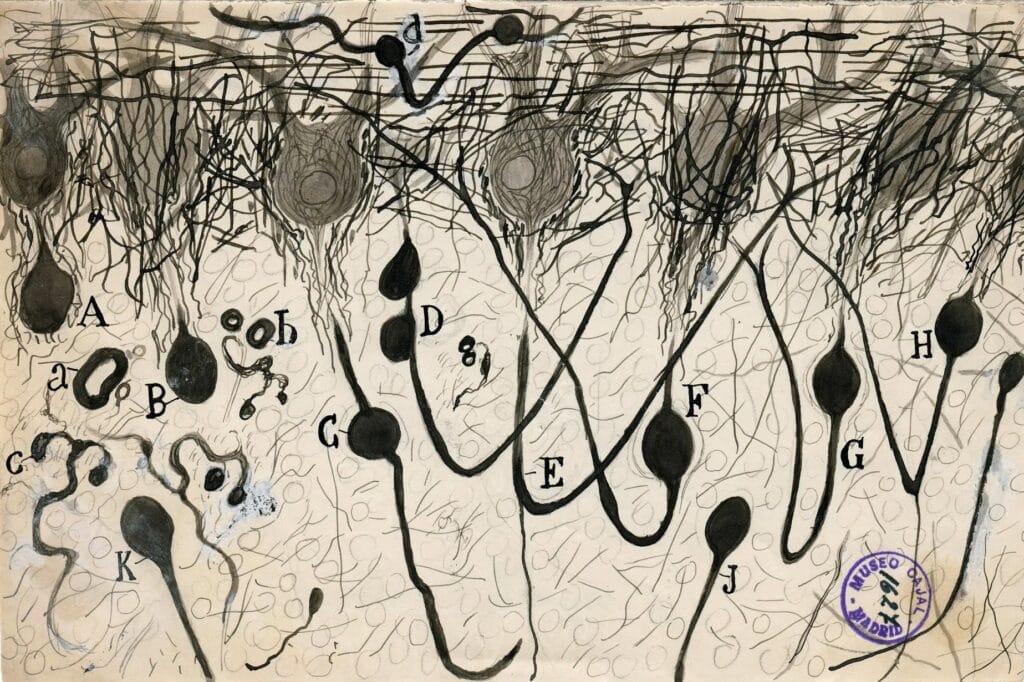
Illustration of axon of Purkinje neurons in the cerebellum of a drowned man by Santiago Ramon y Cajal, ca. 1900
One might propose that one builds relevance out of how one represents things and combines representation. That will not work. Searle, in The Rediscovery of the Mind (1992), pointed out that all representations are aspectual (see also Vervaeke 1997; Vervaeke et. al. 2012). What is an aspect? Out of all the properties that something has, I select a small subset, ignore the vast number of remaining properties, and bind those properties I have selected into a whole that is relevant to me.
For example, consider a pencil. You can see this as…
A weapon—even different kinds of weapons such as a throwing weapon, or a stabbing weapon;
Something useful as the letter I in a mural you are making;
Something you brought back from a trip to California;
Something you could use an example of a tool made by human beings;
A writing implement;
Or something in common use invented after the 1700s;
… And so on.
Consider how many true properties that object actually has. Vast, and you somehow ignore the overwhelming majority of the ones you do not need right now while binding the selected ones together as useful to you in your representation of the object as a pencil. Representations presuppose relevance realization; therefore, they ultimately cannot be the explanatory origin of relevance realization (see Vervaeke et. al. 2012).
Of course you use representations but that is not the issue. So, perhaps we could propose that relevance realization is based on relations of implications? Implication is a logical notion, and we have seen that one cannot be comprehensively logical. However, for the sake of argument let us consider just relations of implication in more everyday usage (See Fodor 2000; 2006). Let us take a proposition: it is going to be windy tomorrow. What are its implications? The number of possible implications, possible relationships to other propositions is astronomical. Checking all of these is not what you do. What you do is you make an inference. Inference is a selection from all of the possible implications of the ones that are relevant to you. So, back to the example where it is going to be windy tomorrow. What should you infer? Well, it depends. It depends on whether I am going sailing tomorrow or going skydiving, or going for a picnic, or flying a kite, or staying in and watching movies. Implication to become inference presupposes relevance realization.
Another option: could we make rule-following the process that generates relevance realization? Rules are propositions from which we make appropriate inference for action. So, already this proposal is in trouble. However, for the sake of argument let us consider the proposal. Rules cannot specify their own conditions of application (See Brown 1988). Let us take a simple rule for action. Be kind. Should I be kind to a student the way I am kind to my romantic partner? That is creepy. Should I be kind to a colleague the way I’m kind to my son? That will not go well. Should I be kind to a stranger the way I’m kind to a colleague, or to my partner, or to my friend? All this will turn out very poorly. Notice that attempting to make rules for applying the first rule will not work because this leads to an expanding infinite regress. This is an argument that Brown (1988) makes in his book on rationality—an argument he says goes back to Wittgenstein clearly, but probably back to Aristotle. This whole process has to terminate in something that is not the application of the rule. It has to terminate in the skill of the judgment of relevance realization.
What about prediction? Could we not just use predictive processing? In prediction one is almost always trying to determine the characteristics of a population based on a limited sample. Here one faces problems of selection bias in which the sample contains patterns not in the population or the sample does not contain patterns that are in the population. Note that there are two different problems here. One is I can miss something in my sample that would be found in the population. This error is called underfitting to the data of the sample. The other error is that I can take something in my sample and think it applies to the population when it does not. This error is overfitting to the data of the sample.
There is no algorithmic solution to deciding what you should do because the problems of underfitting and overfitting are in a trade-off relationship. If I try to reduce misses by becoming more sensitive to my sample I make more mistakes about the population; if I try to get rid of my mistakes by becoming less sensitive to my sample, I miss more actual patterns in the population. How one should decide to predict depends on how relevant a miss or a mistake is in your context.
What about formalization itself? Being a formal system is at the heart of something being computational. Yet, one cannot formalize the process of formalization (See Jaeger et al 2024). This issue is in some ways the deep thing underneath all the other failed proposals for generating relevance realization. The world of problems is divided into two kinds of problems: there are well-defined problems and ill-defined problems. An example of a well-defined problem for you is the problem of 24 x 3. Relevance realization already has been done for you in creating the formal system of multiplication and then teaching you the system and how to properly use it. You know what kind of problem 24 x 3 is: it is a multiplication problem, and that tells you clearly what you should do with a high degree of confidence. You know what the relevant operations are. Singing is irrelevant. You know what the results should be. It should be a number. An astonishingly beautiful picture of a platypus does not work. 24 x 3 is a well-defined problem.
Here’s an ill-defined problem: go on a successful first date. I have been in the wonderful, horrible world of dating multiple times. We all know it is an ill-defined problem because friends often give useless advice. I am straight, so the advice I get is from a straight perspective. The advice is along the following lines. Look into her eyes, but not too much. Laugh at her jokes, not too often. Ask questions, but not too many. The only point of this advice is so that later they can tell me if it went poorly that they told me so.
Most real-world problems are ill-defined problems involving real uncertainty, ambiguity, and dynamical shifting complexity. Taking notes in a lecture or participating in a conversation are further examples. Knowing how close you should stand to somebody at a funeral in Toronto is an ill-defined problem. I did not go to standing school, yet I succeed in this task. The problem of formalization, of creating a formal system and translating the world into that system well, is an ill-defined problem. Once you are in a formal system, you can move around and solve well-defined problems, but getting into the formal system is itself an ill-defined problem. If you propose that you can formalize that process, you get another infinite regress especially given the infinite regress of rule application and the dependence of propositional representations and inferences on relevance realization.

Schrijvende man aan een lessenaar (Man writing at a desk) by Reinier Willem Petrus de Vries (1874-1953)
The connection to McGilchrist’s work should now be clear. The left hemisphere is the hemisphere that glories in the use of rule-governed propositional representations operating within formal systems. I am not saying the left hemisphere is completely absent of relevance realization—it cannot be. What I am saying is that it cannot ground itself—and I am using strictly logical, analytic arguments to show the bloody left hemisphere that it cannot ground itself. What is at the heart of all of this is the whole analytic framework of trying to explain cognition as computation. This is one big performative contradiction. It presupposes relevance realization in all its arguments and theorizing without ever acknowledging or explaining its role. This is why Frank, Gleiser, and Thompson (2024) call relevance realization the blind spot within the current scientific view of cognition.
Please remember, my proposal to you that religio—the core of meaning in life—is relevance realization. Now one should see why religio is so vitally important to you. If you cannot do relevance realization, then you are not a cognitive agent at all. If you are not solving that mattering problem, forget about trying to solve any of your other problems and achieve any of your goals. Matter is more primary than purpose.
Now, I want to point to the astonishing work of Catherine Pickstock (2020). She makes this fantastic argument that all of the divisions that have been given to us by modernity have broken down in the same process of performative contradiction. Kant’s beloved analytic-synthetic dichotomy was famously destroyed by Quine. The fact-value dichotomy has been destroyed by Putnam. For example, is relevance a fact or a value? It is both and neither. Likewise, the theory-data dichotomy has broken down because of arguments by Quine and Duhem. All the great dichotomies that severed our contact with reality have collapsed under analytic argument. Pickstock’s point is that we are back to a conformity theory in which we are coupled to the world. This is an epistemological-ontological connection in which religio is central. That is her argument in her book entitled Aspects of Truth: A New Religious Metaphysics.
We are conforming to a world that is also being shaped by us. We project relevance realization, but then we bind ourselves into it. However, the world also calls to us and draws us in. Relevance realization is not in the object; it is not objective. Something is relevant one minute and irrelevant the next. Neither is it merely subjective because you can be mistaken. You can have an insight like I thought she was angry, but it turns out she was afraid. It is neither subjective nor objective. It is a between. This is where the work of William Desmond (2012) becomes indispensable. His metaxological metaphysics of the between is now gaining recognition (Simpson 2016; Duns 2018).
Relevance realization is also metaxological. Relevance realization is a self-realizing real relation. It is a binding. I have coined a term for this. It is not thrown under you like the subject. It’s not thrown against you like the object. It is thrown between. It is thrown together. I call it transjective. Relevance realization is transjective. It is religio. It is binding. It is connectedness. It is caring. It is mattering. Is food objective or subjective? It is both and neither. It is about an adaptive fit between some aspect of the environment and the autopoiesis of an organism. That connectedness, that religio, and conformity—you put them together and it means that the fundamental grammar of our cognition and the fundamental grammar of reality are co-participating in profound principles of organization.
When you look at that, what does that tell you? It tells you that relationality is primordial like relevance realization. Both belong to a family of connected primordial notions such as information and intelligibility—two inherently relational notions. Also, we judge realness in terms of the intelligibility of information, so realness too is relational. James Filler, in his astonishing book, Heidegger, Neoplatonism, and the History of Being: Relation as Ontological Ground (2023), argues that this is actually something that the Neoplatonic tradition—especially as it was taken up in Christian Neoplatonism—made central. We see this in how the Cappadocian Fathers think about God. For example, ultimate reality is the Trinity which is inherently relational, as are other central Trinitarian notions such as love and logos.
Filler argues we lost the centrality of relationality because Aristotle gave us the wrong metaphysics. We lost a metaphysics that could home mattering when Aristotle said that what is ultimately real are substances. Aristotle did not mean stuff. He meant individually existing things. A substance is like the subject of a sentence and its properties are like the predicate of a sentence. Reality is structured the way subject-predicate language and logic are structured. The problem with that—the devastating problem for Aristotle—is you cannot get relations out of substances. That is what all the previous arguments in this article have shown.
The following is Filler’s argument. Does the relation belong to one of the two substances in relation? Is it a property of that substance? No, because then the substance could have the relation on its own without needing anything else. This argument also applies to the second substance in the relation. Does the relation emerge between two substances? No, for then it exists other than in a substance, in some undefined “space” between them. Filler’s argument is more extensive, but it becomes clear one cannot get relations out of substances. If one worries about this problem of connections and one is convinced that all that really exists are individual, independently existing things, then one gets nominalism. Nominalism argues that all the patterns of connection are really just the way the mind uses language and, of course, now Kant is also lurking nearby. The problems begin when one posits an “out there” separate from a mind that is completely “in here”.
“Out there” does not have those connective patterns of meaning, and therefore the mind becomes a different thing from out there. Mind and “out there” do not touch, let alone conform, so there has to be representation between them and somehow meaning is in the representations. Yet how do we know the representations match reality? So, skepticism looms. Also, the mind and the world must be different substances since fundamentally different principles are at work in each. Dualism emerges. Then the performative contradictions in skepticism and dualism emerge and so one collapses into a materialism in which all that exists are individually existing material objects subject to a meaningless existence. Yet, subject-predicate logic and all such formalizations cannot capture cognition nor its world. It cannot include religio. It cannot include the cognitive agency that generates such a formalized worldview nor the cognition at work within it. We need a metaxological ontology that prioritizes relationality and the metaphysics of mattering. The meaning in our lives ultimately depends on such a worldview. McGilchrist’s work is about exactly this.
Works Cited
Allen, K. A., Kern, M. L., Rozek, C. S., McInerney, D. M., & Slavich, G. M. (2021). Belonging: A Review of Conceptual Issues, an Integrative Framework, and Directions for Future Research. Australian journal of psychology, 73(1), 87-102.
Andersen, B. P., Miller, M., & Vervaeke, J. (2022). Predictive Processing and Relevance Realization: Exploring Convergent Solutions to the Frame Problem. Phenomenology and the Cognitive Sciences, 24, 359–380.
Brown, H. I. (1988). Rationality. Routledge.
Cherniak, C. (1990). Minimal Rationality. Mit Press.
Costin, V. and Vignoles, V.L., 2020. Meaning is about Mattering: Evaluating Coherence, Purpose, and Existential Mattering as Precursors of Meaning in Life Judgments. Journal of Personality and Social Psychology, 118(4), p.864.
Deary, I. J. (2020). Intelligence: A Very Short Introduction (Vol. 39). Oxford University Press, USA.
Desmond, W. (2012). The William Desmond Reader. State University of New York Press.
Doctor, T., Witkowski, O., Solomonova, E., Duane, B., & Levin, M. (2022). Biology, Buddhism, and AI: Care as the Driver of Intelligence. Entropy, 24(5), 710.
Duns, R. G. (2018). Spiritual Exercises for a Secular Age? William Desmond’s Theological Achievement. [Doctoral dissertation, Boston College]. University Repository at Boston College.
Filler, J. (2023). Heidegger, Neoplatonism, and the History of Being: Relation as Ontological Ground. Springer Nature.
Fodor, J. A. (2000). The Mind Doesn’t Work that Way: The Scope and Limits of Computational Psychology. MIT press.
Fodor, J. (2006). How the Mind Works: What We Still Don’t Know. Daedalus, 135(3), 86-94.
Frank, A., Gleiser, M., & Thompson, E. (2024). The Blind Spot: Why Science Cannot Ignore Human Experience. MIT Press.
Friston, K. (2009). The Free-Energy Principle: A Rough Guide to the Brain?. Trends in Cognitive Sciences, 13(7), 293-301.
Friston, K. (2010). The Free-Energy Principle: A Unified Brain Theory?. Nature Reviews Neuroscience, 11(2), 127-138.
Jaeger, J., Riedl, A., Djedovic, A., Vervaeke, J., & Walsh, D. (2024). Naturalizing Relevance Realization: Why Agency and Cognition are Fundamentally not Computational. Frontiers in Psychology, 15, 1362658.
Laudan, L. (1983). The Demise of the Demarcation Problem. Physics, Philosophy, and Psychoanalysis: Essays in Honor of Adolf Grünbaum. Springer.
Martela, F., & Steger, M. F. (2016). The Three Meanings of Meaning in Life: Distinguishing Coherence, Purpose, and Significance. The Journal of Positive Psychology, 11(5), 531-545.
Martela, F. and Steger, M.F., (2023). The Role of Significance Relative to the Other Dimensions of Meaning in Life – An Examination Utilizing the Three-Dimensional Meaning in Life Scale (3DM). The Journal of Positive Psychology, 18(4), 606-626.
Montague, R. (2007). Your Brain is (Almost) Perfect: How We Make Decisions. Penguin.
Pickstock, C. (2020). Aspects of Truth: A New Religious Metaphysics. Cambridge University Press.
Searle, J. R. (1992). The Rediscovery of the Mind. Bradford Books.
Simpson, C. B. (2016). Religion, Metaphysics, and the Postmodern: William Desmond and John D. Caputo. Wipf and Stock Publishers.
Spearman, C. (1904). General Intelligence, Objectively Determined and Measured. The American Journal of Psychology, 15(2), 201–292.
Vervaeke, J. A. (1997). The Naturalistic Imperative in Cognitive Science. [Doctoral dissertation, University of Toronto]. University of Toronto TSpace.
Vervaeke, J., & Coyne, S. (2023). Mentoring the Machines. Story Grid Publishing LLC.
Vervaeke, J., & Ferraro, L. (2013). Relevance Realization and the Neurodynamics and Neuroconnectivity of General Intelligence. SmartData: Privacy Meets Evolutionary Robotics, 57-68. Springer.
Vervaeke, J., Lillicrap, T. P., & Richards, B. A. (2012). Relevance Realization and the Emerging Framework in Cognitive Science. Journal of Logic and Computation, 22(1), 79-99.
Vervaeke, J., Mastropietro, C., & Abramian., (2024). Awakening from the Meaning Crisis Book One: Origins. Story Grid Publishing LLC.
Wolf, S. (2012). Meaning in Life and Why it Matters. Princeton University Press.