
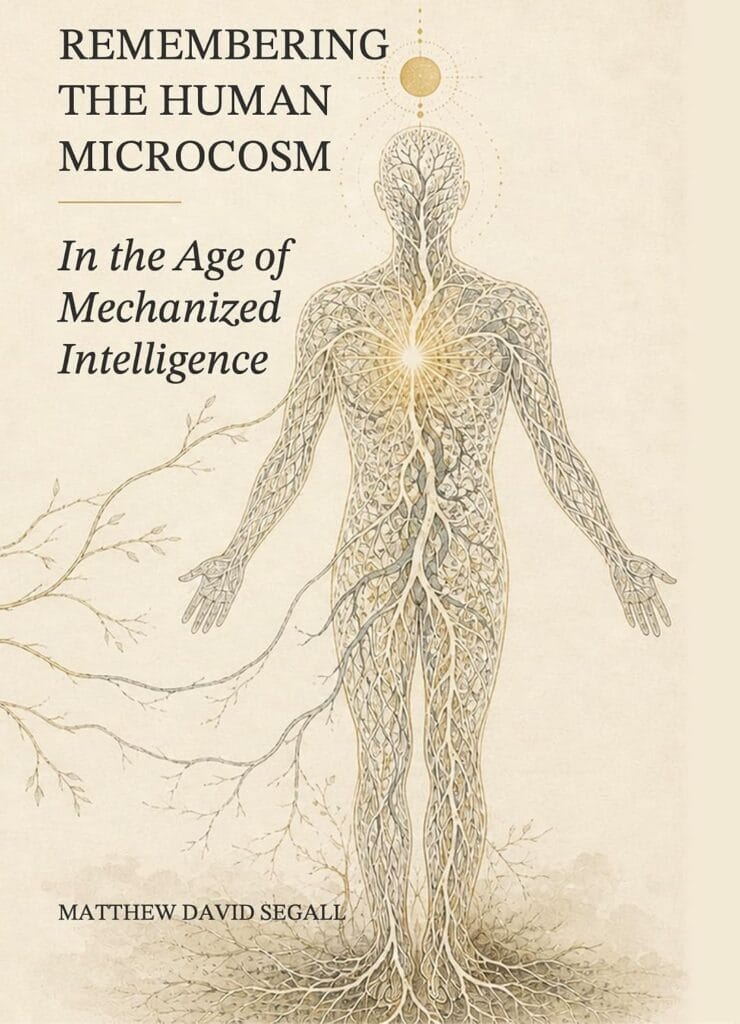
Remembering the Human Microcosm in the Age of Mechanized Intelligence
- By Matthew David Segall
- July 30, 2026
As technologies of automated computation rapidly transform human culture, we are being urged to believe that human minds are machines and machines are potentially minds. But what if the question of machine consciousness is not a hard problem awaiting better theories and technologies, but malformed—born from a metaphysics that first exiled feeling, purpose, and meaning from nature?
Remembering the Human Microcosm in the Age of Mechanized Intelligence challenges the corporate myth of “artificial intelligence” and the emerging threat of cognitive enclosure: the attempt to meter and monetize our very capacity for thought. Moving from Pope Leo XIV’s warnings about AI to the deeper history of media technologies, Segall enlists Georg Hegel, Alfred North Whitehead, and Raymond Ruyer as allies in the resistance against the mechanization of mind.
Hegel’s loom clarifies the difference between living Reason and its mechanical imitation. Whitehead reveals Reason not as a private human possession but as a cosmic power that our species intensely concentrates. Ruyer shows why machines may conserve, transmit, and recombine information without originating meaning.
- Get a Copy of Remembering the Human Microcosm in the Age of Mechanized Intelligence
About the Author(s)

Dr. Matthew David Segall is the Director of the Process & Science Network, and a transdisciplinary researcher and teacher applying process philosophy across the natural and social sciences, including the study of consciousness. He is Assistant Professor in the Philosophy, Cosmology, and Consciousness Program at California Institute of Integral Studies in San Francisco, CA. Matt is author of Crossing the Threshold: Etheric Imagination in the Post-Kantian Process Philosophy of Schelling and Whitehead (Integral Imprint, 2023) and Physics of the World-Soul: Alfred North Whitehead’s Adventure in Cosmology (SacraSage Press, 2021). Follow his work at Footnotes2Plato.com
More Books