
An Unlikely Conversation with an Urgent Purpose
We can imagine a joke that might begin with: A philosopher, a theologian, a scientist, and an artist walk into a bar…
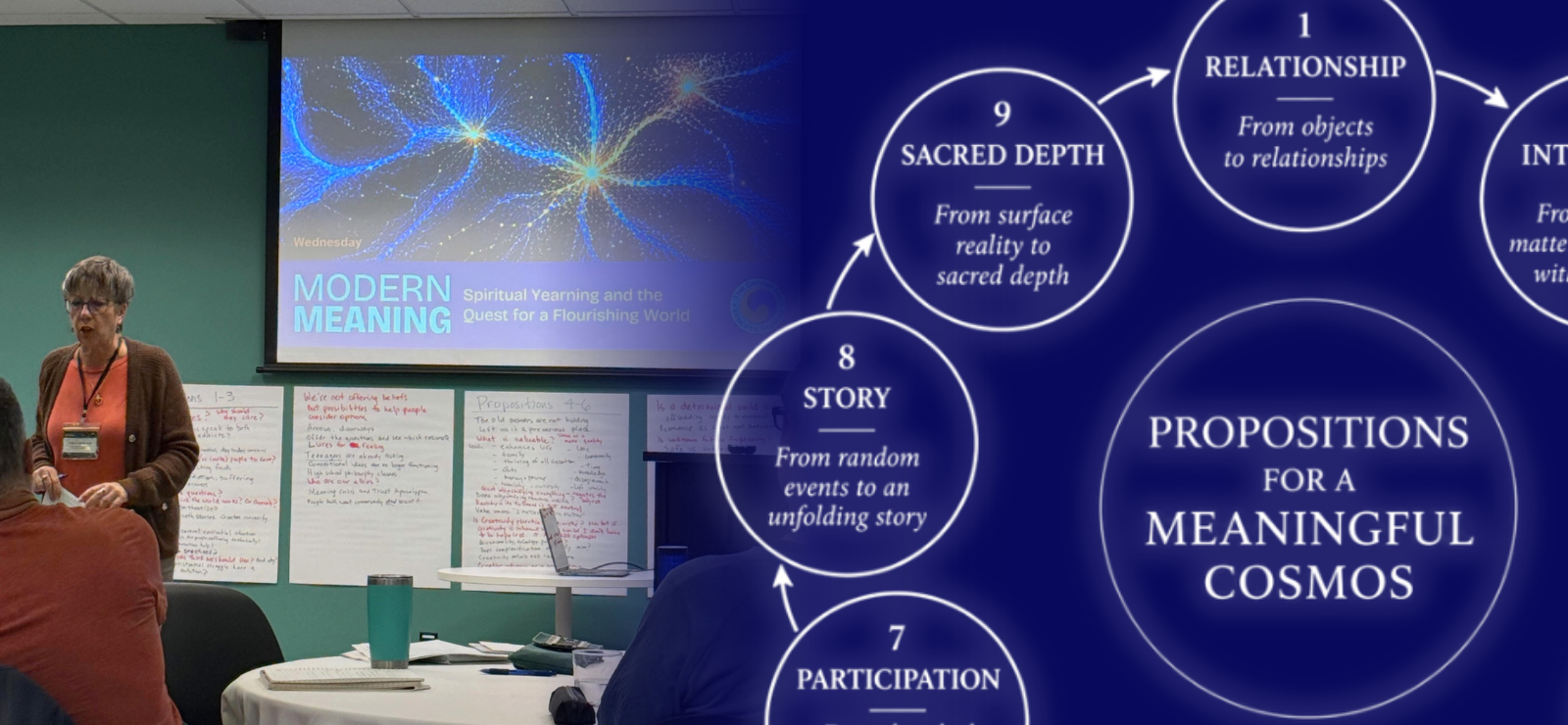
And while it may be difficult to imagine the conversation that could ensue, let alone a punchline, the Center for Process Studies did indeed host a gathering like that to kick off our project funded by the John Templeton Foundation, Modern Meaning: Spiritual Yearning and the Quest for a Flourishing World. Eighteen of us gathered at Hope College in Holland, Michigan to talk metaphysics and meaning and the conversations exceeded our expectations.
Why bring such an unusual collection of people together? Because beneath many of the challenges we face—from loneliness and disconnection to uncertainty about the future—lies a question of meaning. Does the universe have room for purpose, value, and belonging, or are these merely comforting stories we tell ourselves? We suspect that the picture of reality many of us have inherited shapes how we answer that question. And we believe it is worth asking whether another picture is possible.
A Gathering of Curious Colleagues
Our eighteen participants brought together an extraordinary range of perspectives: philosophers, theologians, psychologists, biologists, a physicist, a filmmaker, a poet, and visual artists. Included were Sheri Kling and Andrew Davis, project leads, Andrew Schwartz, John Vervaeke, Steven Peck, Timothy Jackson, Timothy Eastman, Philip Clayton, Shaleen Kendrick, Jonathan Mize, and Matt Segall, empirical researcher Daryl Van Tongeren, Christof Wolf, Drew Dellinger, Damian Geddry, and three talented animators connected with OCAD University: Kaeti MacNeil, Raven Myers, and Penakee Das.
What a rich gathering indeed!
What made these conversations so bountiful was not that everyone agreed. Quite the opposite. Our participants brought different disciplinary commitments, different understandings of evidence, and different intuitions about what the universe might be like. That diversity was precisely what we needed. Our goal was not to establish a new orthodoxy but to discover which possibilities could withstand serious questioning—and which might open genuinely new ways of thinking.
Some of our most fruitful exchanges began with deceptively simple questions. What do we mean by consciousness? Could the ways single-celled organisms move toward favorable conditions and away from harmful ones offer a doorway into thinking about value? We also considered how scientific methods that isolate systems for study can reveal their own limits: real systems are embedded in contexts and relationships. These examples did not settle our metaphysical questions, but they gave us new ways to ask them.
And behind those questions were deeply human concerns: loneliness, depression, disconnection, and the search for a life that feels meaningful.
Nine Propositions for a Meaningful Cosmos
We came together to explore nine propositions—nine invitations to consider a picture of reality that might be more relational, creative, and life-giving than the mechanistic and reductionist assumptions often associated with modern science in the wider culture.
These propositions were not offered as nine claims that everyone had to accept. We called them provocations, possibilities, and, borrowing Whitehead’s language, “lures for feeling.” Each opens a different window onto reality; together, they invite us to ask whether the world might be more relational, participatory, creative, meaningful, and open to sacred depth than we ordinarily imagine.
Participants were free to question the propositions, challenge their order, and suggest revisions or combinations. That was the point: to put promising ideas into genuine interdisciplinary conversation.
We arranged them in a sequence, beginning with relationships and the nature of experience, moving through intelligence, value, creativity, freedom, and participation, and ending with the possibility of an unfolding cosmic story and sacred depth. We wanted to see not only what each invitation might illuminate on its own, but also what new possibilities might emerge when they were considered together.
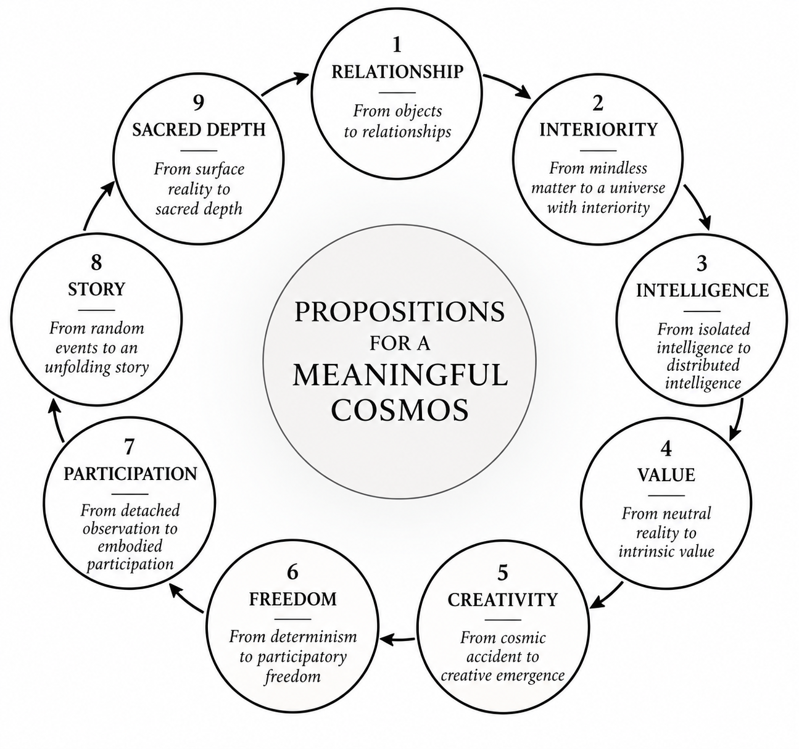
For each proposition, we contrasted a “conventional view” with an “alternative invitation,” explored possible scientific and philosophical doorways, and asked the essential “So what?” question: What difference could this way of seeing make to someone searching for meaning today?
By “conventional view,” we do not mean the consensus of contemporary science, or assume that most scientists or members of the public hold these ideas. We mean a picture of reality that has become influential in modern culture and is often presented as what science tells us about the world. Many scientists are themselves questioning aspects of that picture. Our aim is not to reject science, but to bring scientific findings and philosophical reflection into a more open conversation about what reality might be like.
| Transition | Conventional View | Alternative Invitation |
|---|---|---|
| 1. From Separation to Individuals in Relationship | Reality is primarily made of separate things whose interactions are secondary to what they are. | What if reality is better understood as a web of relationships and processes from which things emerge? |
| 2. From Mindless Matter to a Universe with Interiority | Consciousness is a rare accident that emerged in highly complex brains. | What if consciousness or experience is a fundamental feature of reality rather than a late evolutionary accident? |
| 3. From Isolated Intelligence to Distributed Intelligence | Intelligence exists only in individual brains. | What if intelligence and problem-solving are distributed throughout living systems? |
| 4. From Neutral Reality to Intrinsic Value | Value exists only because humans create or assign it. | What if value is woven into reality itself and discovered rather than merely invented? |
| 5. From Cosmic Accident to Creative Emergence | Novelty is an accidental byproduct of blind processes. | What if creativity is a fundamental feature of the cosmos? |
| 6. From Determinism to Participatory Freedom | The future is entirely determined by prior physical causes. | What if the future remains genuinely open and is shaped through participation and choice? |
| 7. From Detached Observation to Embodied Participation | Knowledge comes primarily through detached analysis and objective observation. | What if feeling, embodiment, beauty, intuition, and lived experience are also valid ways of knowing? |
| 8. From Random Events to an Unfolding Story | The universe is ultimately a collection of unrelated events without overarching significance. | What if the cosmos can be understood as an unfolding story of increasing complexity, relationship, meaning, and possibility? |
| 9. From Surface Reality to Sacred Depth | Reality is only what appears on the surface; any deeper or sacred meaning is something we project onto it. | What if reality is deeper than appearances suggest and can be encountered as meaningful, valuable, and sacred? |
These propositions served as starting points rather than settled conclusions. Throughout the symposium, participants challenged assumptions, refined distinctions, and suggested alternative formulations. Their contributions are now informing a revised set of propositions that will guide the project’s next phases of research and public engagement.
At the gathering, we met in small groups of four or five to discuss individual propositions, then reconvened as a larger group to reflect on them in sets of three. The schedule was intense, the conversations were electrifying, and shared meals in downtown Holland gave us welcome opportunities to keep talking. We did not leave with every question resolved. We left with sharper questions, promising connections, and plenty of work to do.
Throughout the gathering, our visual artists listened, sketched, and imagined how abstract ideas might become compelling stories. Their work sparked the creativity of the whole group and reminded us that meaning is not discovered through analysis alone. Imagination, beauty, and creative expression can help people encounter a possibility before they have all the words to explain it. That matters for a project that hopes to reach well beyond an academic audience.
What Comes Next
But will these invitations resonate with people beyond our symposium? Might a different picture of reality shape how people think about meaning, hope, and purpose? We cannot answer those questions through philosophical reflection alone. The next phase involves empirical research led by psychologist Daryl Van Tongeren at Hope College, working with colleagues at two other institutions.
The researchers will explore how participants respond to the nine invitations and examine measures related to meaning and well-being. Alongside this work, we will continue developing the creative materials. The research findings will help shape an online course and video series featuring animated visualizations, designed to make these questions accessible to a wider public.
We at CPS are grateful for the support of the John Templeton Foundation and for the imagination and intellectual generosity of everyone who joined us. We do not imagine that nine propositions can solve the world’s crisis of meaning. But the stories we tell about reality have consequences for how we live. What might change if we came to see ourselves not as isolated accidents in an indifferent universe, but as participants in a deeply relational, creative, and potentially meaningful cosmos? That is the question at the heart of Modern Meaning. We look forward to discovering where it leads.
If you would like to help extend the reach of Modern Meaning, please consider making a gift designated for the Modern Meaning Project.
This project/publication was made possible through the support of Grant 63861 from the John Templeton Foundation. The opinions expressed in this publication are those of the author(s) and do not necessarily reflect the views of the John Templeton Foundation.