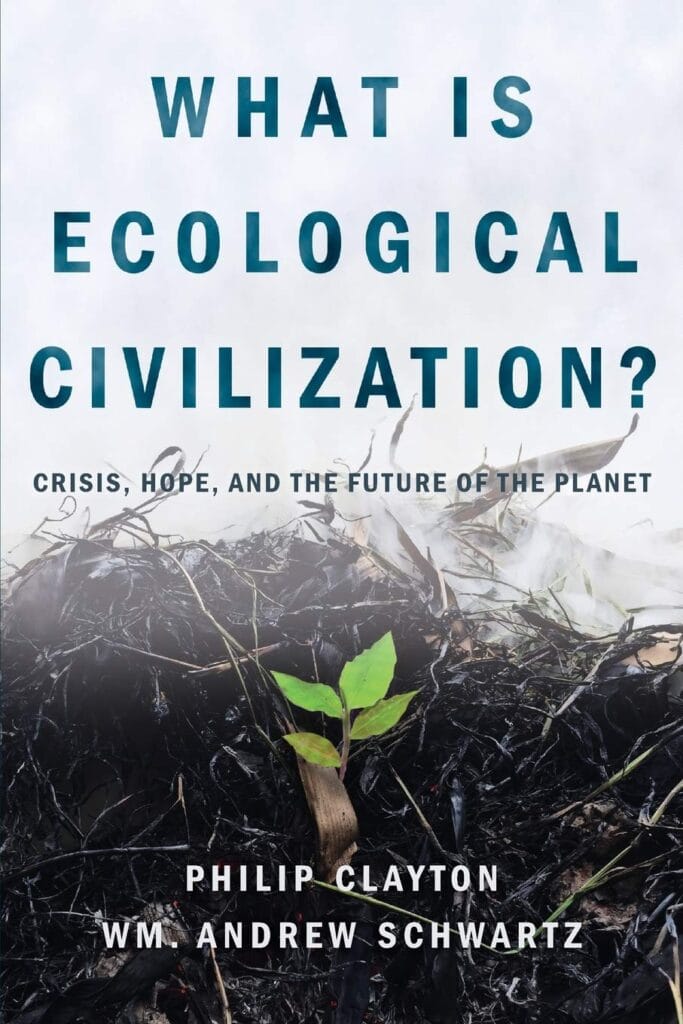
What Is Ecological Civilization?: Crisis, Hope, and the Future of the Planet
- By Philip Clayton and Wm. Andrew Schwartz
- August 17, 2019
- Process Century Press
The present trajectory of life on this planet is unsustainable, and the underlying causes of our environmental crisis are inseparable from our social and economic systems. The massive inequality between the rich and the poor is not separate from our systems of unlimited growth, the depletion of natural resources, the extinction of species, or global warming. As climate predictions continue to exceed projections, it is clear that hopelessness is rapidly becoming our worst enemy. What is needed—urgently—is a new vision for the flourishing of life on this planet, a vision the authors are calling an ecological civilization. Along the way they have learned that this term brings hope unlike any other. It reminds us that humans have gone through many civilizations in the past, and the end of a particular civilization does not necessarily mean the end of humanity, much less the end of all life on the planet. It is not hard for us to conceive of a society after the fall of modernity, in which humans live in an equitable and sustainable way with one another and the planet. This book explores the idea of ecological civilization by asking eight key questions about it and drawing answers from relational philosophies, the ecological sciences, systems thinking and network theory, and the world’s religious and spiritual traditions. It concludes that a genuinely ecological civilization is not a utopian ideal, but a practical way to live. To recognize this, and to begin to take steps to establish it, is the foundation for realistic hope.
- Get a Copy of What Is Ecological Civilization?: Crisis, Hope, and the Future of the Planet
About the Author(s)

Dr. Philip Clayton has taught for several decades at Claremont School of Theology; written or edited 26 books; held guest professorships at Harvard, Univ. of Cambridge, and Munich; founded (with Andrew Schwartz) the Institute for Ecological Civilization; worked with Zhihe Wang and Meijun Fan for 15 years as president of the Institute for the Postmodern Development of China; and supported interfaith partnerships around the world. As a scholar he explores the intersections of philosophy, theology, and science; as an activist he works toward the development of an ecological civilization. He is particularly interested in the evolving understanding of Christian faith in the 21st century, and the societal changes that are necessary for establishing sustainable forms of civilization on this planet.

Dr. Wm. Andrew Schwartz is a scholar, educator, and activist working at the intersection of process philosophy, ecological civilization, and global cross-cultural engagement. He currently serves as Executive Director of the Center for Process Studies (CPS), Co-Founder & Vice President of the Institute for Ecological Civilization (EcoCiv), and Associate Professor of Process Studies and Comparative Philosophy at Claremont School of Theology (CST). His research and teaching covers a wide range of topics, such as environmental philosophy, philosophy of religion, Asian and comparative philosophies, metaphysics, economic philosophy, philosophy of mind, philosophy of education, and more. However, his current work mainly focuses the application of process philosophy in understanding reality, understanding humanity, and understanding how best to organize systems of society for ecological civilization. He is author/editor of 7 books, including What is Ecological Civilization (2019) and The Metaphysics of Paradox (2018). Most recently, he spent the 2025–26 academic year in China as Visiting Associate Professor at Beijing Normal–Hong Kong Baptist University (BNBU) in Zhuhai, China. As Executive Director, Andrew has overall strategic and operational responsibility for CPS, including development and implementation of the CPS mission, programs, and strategic vision.
More Books