
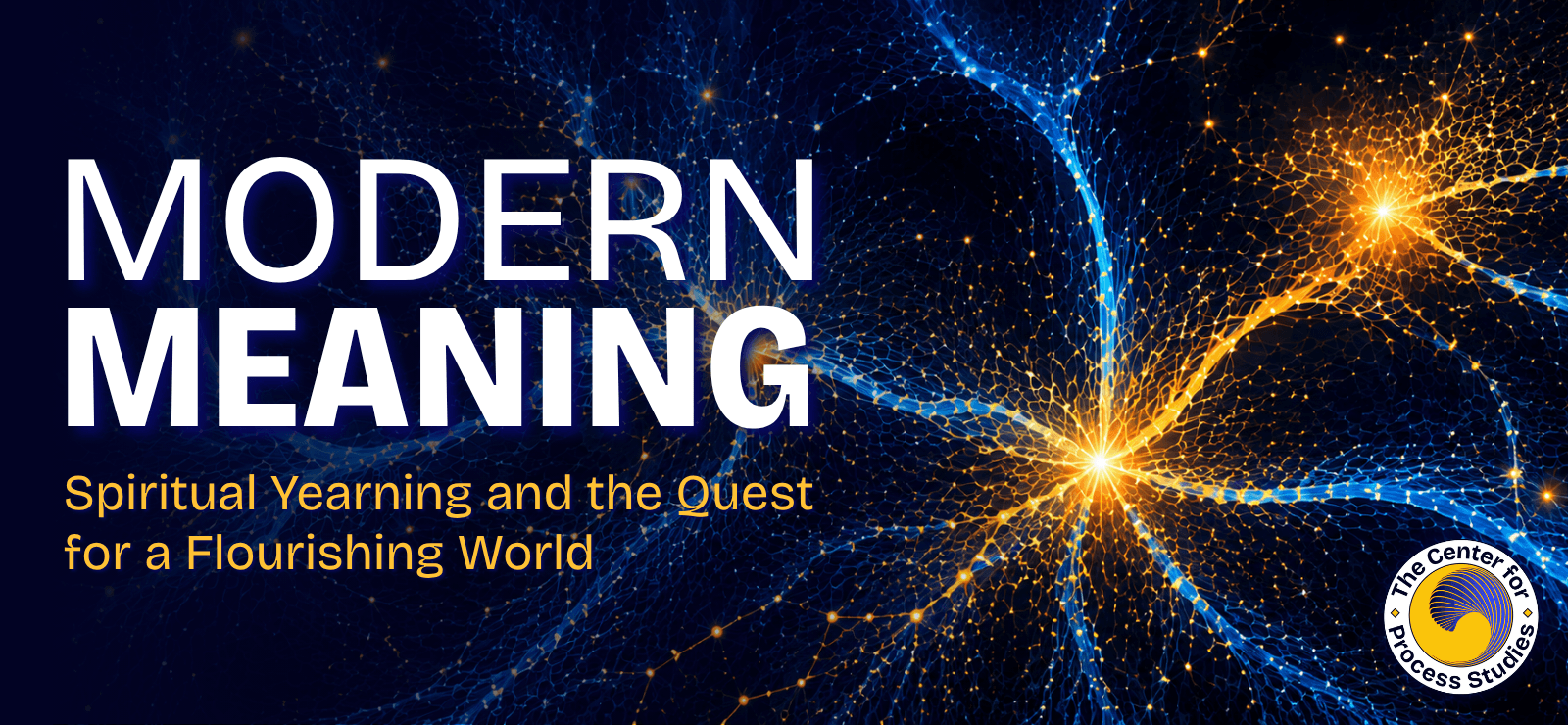
PORTLAND, Oregon — August 10, 2026 — The Center for Process Studies (CPS) has been awarded a grant (#63861) from the John Templeton Foundation to launch an innovative interdisciplinary project entitled Modern Meaning: Spiritual Yearning and the Quest for a Flourishing World. The initiative brings together scholars from philosophy, theology, psychology, and the natural sciences to investigate one of the defining questions of our time: How can contemporary understandings of the universe support lives of meaning, purpose, and hope?
Across many disciplines, researchers have noted growing concern about a modern “meaning crisis,” particularly among younger adults, alongside renewed philosophical and scientific interest in questions of consciousness, intelligence, and the nature of reality. The project will explore how different philosophical, metaphysical, and theological frameworks—including panentheistic, panpsychic, and process-relational perspectives—may help illuminate these questions while remaining in constructive dialogue with contemporary science.
“Our goal is not to advance a single worldview as the final answer,” said project lead Dr. Sheri D. Kling. “Rather, we want to create a rigorous interdisciplinary conversation that asks whether emerging understandings of mind, nature, and value can contribute to a more coherent and meaningful vision of reality—one that resonates both intellectually and existentially.”
The project will unfold through four interconnected phases:
- An interdisciplinary working symposium bringing together leading scholars, scientists, artists, and communicators to refine key conceptual questions and frameworks.
- An empirical research study led by psychologist of meaning Dr. Daryl Van Tongeren, examining how different metaphysical perspectives influence meaning-making and worldview coherence among college students.
- A collaborative integration phase in which symposium participants refine conceptual insights in light of empirical findings.
- A public education initiative featuring an online course and video series that translate the project’s findings into engaging and accessible resources for broader audiences.
Project Co-Lead Dr. Andrew M. Davis, Research and Academic Director of the Center for Process Studies, emphasized the project’s interdisciplinary character.
“This initiative brings philosophers, theologians, scientists, psychologists, and artists into genuine collaboration around questions that no single discipline can answer alone. It represents exactly the kind of integrative inquiry needed to address contemporary questions about consciousness, meaning, and human flourishing.”
By combining conceptual inquiry, empirical research, and public education within a single initiative, the project seeks to create an ongoing conversation that extends well beyond the academy.
Founded in 1973, the Center for Process Studies has spent more than five decades fostering interdisciplinary scholarship at the intersection of philosophy, theology, science, ecology, and culture. This new project continues that tradition by combining conceptual inquiry, empirical research, and public engagement in pursuit of a deeper understanding of how models of reality shape human experience.
The project is supported through a grant from the John Templeton Foundation. The opinions expressed in this publication are those of the authors and do not necessarily reflect the views of the John Templeton Foundation.
You can download a PDF copy of the press release here.
About the Center for Process Studies
The Center for Process Studies is an independent research center dedicated to advancing interdisciplinary dialogue on philosophy, theology, spirituality, science, ecology, and human flourishing. Through research, publications, educational initiatives, and global partnerships, CPS explores process-relational approaches to understanding reality and addressing the challenges of the contemporary world.
About the John Templeton Foundation
Founded in 1987, the John Templeton Foundation supports interdisciplinary research and catalyzes conversations that inspire awe and wonder. We are working to create a world where people are curious about the wonders of the universe, free to pursue lives of meaning and purpose, and motivated by great and selfless love. With an endowment of $4 billion and annual giving of approximately $150 million, the Foundation ranks among the 30 largest grantmaking foundations in the United States. Headquartered outside Philadelphia, our philanthropic activities have engaged all major faith traditions and extended to more than 60 countries around the world. For more information, visit www.templeton.org.